
Key Takeaways
- Five characters, ten builds: each character in Slay the Spire 2 supports at least two distinct deck archetypes, and knowing when to commit or pivot is what separates a win from a floor 30 wipe
- Ironclad dominates through Strength scaling or Exhaust cycling: stack Demon Form and multi-hit attacks, or run the Corruption/Dark Embrace/Feel No Pain engine for explosive turns
- Silent’s new Sly keyword changes everything: discard-based builds now play cards for free when discarded, making her damage ceiling virtually limitless alongside the classic Poison Catalyst combo
- Defect’s Claw deck is back and better: zero-cost attack spam with All for One creates infinite-feeling turns, while Orb/Focus builds offer a more methodical scaling path
- The Regent rewards patience: Stars persist between turns with no cap, and the Sovereign Blade gains permanent damage through Forging, but slow setups get punished hard in Act 2
- Necrobinder is high risk, high reward: Osty absorbs hits while you stack Doom for instant-kill thresholds, or cycle Souls and exhaust cards for an infinite loop engine
Slay the Spire 2 launched into Early Access on March 5, 2026, and within hours the subreddit was flooded with posts about how brutally difficult it is. The sequel brings back three returning characters (Ironclad, Silent, Defect) and introduces two completely new ones (The Regent and The Necrobinder), each with unique mechanics that reward specific deck archetypes.
If you are still getting comfortable with the basics, check out our Slay the Spire 2 beginner guide first. This article goes deeper: two proven builds per character, the key cards that make each build work, which relics to prioritize, and when to pivot if the Spire is not giving you what you need. We also have a dedicated relic tier list if you want the full ranking.
Deckbuilding Fundamentals That Apply to Every Character
Before diving into specific builds, there are a few universal principles that separate consistent climbers from players who hit a wall in Act 2.
Play the deck the Spire gives you, not the one you want. The biggest mistake new players make is forcing an archetype from floor one. If you are playing Silent and want Poison but the card rewards keep offering Shiv cards, take the Shivs. Flexibility wins runs.
Keep your deck between 25 and 30 cards. A lean deck draws your key cards more often. Removing Strikes and Defends at shops and rest sites is one of the highest-value plays in the game, especially after Act 1.
Prioritize card removal over card addition. Every weak card in your deck dilutes your draws. Removing a Strike often does more for your win rate than adding a mediocre attack.
Draft for Act 1 survival first, then scale. A scaling power like Demon Form is worthless if you die to the Act 1 boss. Grab reliable damage and block early, then layer in your build’s engine pieces during Acts 2 and 3. Our Slay the Spire 2 boss guide breaks down every boss’s attack patterns so you know exactly what to prepare for.
Ironclad Builds
The Ironclad is the most forgiving character in Slay the Spire 2. His starting relic, Burning Blood, heals 6 HP after every combat, which gives you room to take risks early. He excels at two things: stacking Strength for massive damage and burning through his own deck with Exhaust synergies.
Strength Scaling Build
This is Ironclad’s signature archetype. You stack Strength through powers and skills, then cash in with multi-hit attacks that multiply that Strength on every single hit.
Core cards: Demon Form (3 Strength per turn permanently), Limit Break (doubles your current Strength), Inflame and Spot Weakness for early Strength, and any multi-hit attack: Sword Boomerang, Twin Strike, Whirlwind, or Heavy Blade.
How it works: Play Demon Form early in a fight and survive for two or three turns while your Strength stacks. Once you hit double digits, a single Whirlwind or Sword Boomerang deals hundreds of damage. Upgraded Limit Break does not exhaust, which means you can double your Strength every time you draw it.
Key relics: Orichalcum (passive Block while ramping), Horn Cleat and Captain’s Wheel (defensive padding). Vajra and Girya add permanent Strength. If you find Reaper, it becomes your primary healing tool since every point of Strength increases how much HP you recover.
When to pivot: If you reach mid-Act 2 without finding Demon Form, Limit Break, or a reliable Strength source, consider shifting toward the Exhaust build. You can still use Strength cards, but you will need a different engine to carry late fights.
Exhaust Engine Build
The Exhaust build turns card removal into a resource. You deliberately exhaust cards to trigger powerful payoff effects, cycling through your deck in a single turn.
Core cards: Corruption (all Skills cost 0 but exhaust when played), Dark Embrace (draw a card whenever you exhaust), Feel No Pain (gain Block whenever you exhaust). These three form the “holy trinity” of Ironclad Exhaust. Juggernaut deals damage every time you gain Block, which triggers constantly when you are cycling.
How it works: Once Corruption is active, every Skill in your deck becomes free. Dark Embrace replaces each exhausted card with a fresh draw, and Feel No Pain stacks Block with every exhaust. The result is explosive turns where you play 10 to 15 cards, generate massive Block, and deal damage through Juggernaut triggers.
Key relics: Dead Branch is the dream relic here. It generates a random card every time you exhaust one, preventing you from running out of cards entirely. Medical Kit lets you exhaust Status cards for even more triggers. Blue Candle makes Curses playable fuel.
When to pivot: This build needs Corruption to function. If you do not find it by the Act 2 boss, lean into a Block/Body Slam hybrid instead. Barricade (Block carries over between turns) plus Body Slam (deals damage equal to your Block) is a reliable backup plan.
Silent Builds
The Silent has the highest skill ceiling in Slay the Spire 2 but no built-in healing. Her starting relic, Ring of the Snake, draws 2 extra cards on turn one, giving her fast starts. The new Sly keyword is what makes her STS2 version especially dangerous.
Sly Discard Engine
This is the build that experienced players are calling the strongest in Early Access. The Sly keyword automatically plays a card for free when it is discarded from your hand, which flips the idea of “discarding” from a cost into a benefit.
Core cards: Any card with the Sly keyword, plus discard outlets like Acrobatics and Calculated Gamble. You want cards that discard your hand or specific cards, which triggers all your Sly cards to play themselves for zero energy.
How it works: Fill your hand with Sly cards, then play a mass discard like Calculated Gamble. Every Sly card in your hand activates for free, dealing damage and generating Block without spending any energy. The damage ceiling is virtually unlimited because you are playing multiple cards per discard.
Key relics: Tough Bandages (gain Block when discarding), Hovering Kite (gain energy the first time you discard each turn), Tingsha (deal damage when discarding). These relics turn every discard into extra value on top of the Sly triggers.
When to pivot: If Sly cards are not showing up in rewards, default to Poison. The discard shell still works as a draw engine even without Sly payoffs, so keep Acrobatics regardless.
Poison Catalyst Build
The classic Silent archetype returns. Apply Poison, then use Catalyst to double or triple the stacks, and let the enemy melt on their own turn while you focus on blocking.
Core cards: Deadly Poison and Noxious Fumes for consistent application, Catalyst to multiply stacks (upgraded Catalyst triples instead of doubles), Corpse Explosion to spread Poison damage on kill, and Burst to copy Catalyst for absurd scaling.
How it works: Apply Poison through cheap skills, then play Catalyst to double the stacks. A Burst into Catalyst doubles twice, turning 10 Poison into 40 in a single action. Noxious Fumes provides passive application every turn, which means your Poison stacks keep growing even when you focus entirely on blocking.
Key relics: Snecko Skull (extra Poison per application), The Specimen (Poison transfers to another enemy on kill). Envenom adds Poison whenever you deal attack damage, which bridges the gap between Poison and Shiv cards.
When to pivot: Watch for enemies with Artifact (blocks debuffs including Poison). If you see multiple Artifact-heavy fights on the map, supplement with Shiv attacks for direct damage. Blade Dance and Accuracy work well alongside Poison as a secondary damage source.
Defect Builds
The Defect returns with its Orb system intact and a rebuilt chassis. Cracked Core, the starting relic, channels one Lightning Orb at combat start. The Defect’s builds split between a passive Orb engine and an aggressive zero-cost attack strategy.
Orb/Focus Scaling Build
The methodical approach. Channel Frost Orbs for Block, Lightning Orbs for damage, and stack Focus to increase every Orb’s output each turn.
Core cards: Defragment (permanent Focus), Glacier (channels 2 Frost Orbs plus Block), Ball Lightning (channels Lightning), Electrodynamics (Lightning hits all enemies), Cold Snap (channels Frost), and Cool Headed (channels Frost plus card draw).
How it works: Fill your Orb slots with Frost Orbs, then stack Focus with Defragment. Each Frost Orb passively generates Block equal to 2 plus your Focus every turn. At 5 Focus with 3 Frost Orbs, that is 21 free Block per turn before playing a single card. Lightning Orbs handle damage on the same passive scaling.
Key relics: Calipers (Block carries over between turns, insane with Frost Orbs), Mummified Hand (playing Powers generates energy, great for Defragment chains), Inserter (gain an extra Orb slot every 2 turns).
Dark Orb variant: Channel a single Dark Orb and let it grow. Dark Orbs gain damage equal to 6 plus your Focus every turn passively. After 5 or 6 turns, use Multicast or Dualcast to evoke it for 100-plus damage in one hit. This variant is slower but can one-shot bosses.
Claw Spam Build
The Defect’s aggro build. Claw is a zero-cost attack that permanently gains damage every time you play any Claw during the combat. Stack cheap attacks and cycle through your deck as fast as possible.
Core cards: Claw (0 cost, gains +2 damage permanently per Claw played), All for One (plays every 0-cost card from your discard pile back to your hand), Scrape (draws cards and discards non-attacks), FTL (0-cost attack with card draw), and Go for the Eyes (0-cost with Weak application).
How it works: Play Claws to ramp their damage. Use Scrape and draw cards to cycle through your deck fast, then play All for One to pull every Claw, FTL, and Go for the Eyes back from discard. Each cycle increases Claw damage permanently. By the third cycle, each Claw hits for 14 or more.
Key relics: Nuclear Battery (extra energy without disrupting Orbs), Shuriken and Kunai (trigger off the volume of attacks played per turn), Ornamental Fan (Block generation from attack spam). Hologram lets you retrieve 0-cost cards from discard manually.
When to pivot: Claw needs density. If you only find one Claw by Act 2, the damage will not scale fast enough. Shift into Orb/Focus instead and use whatever 0-cost attacks you have as energy-efficient filler.

The Regent Builds
The Regent is one of two new characters in Slay the Spire 2. He is described as an arrogant, star-headed alien royal, and his playstyle matches: patient, methodical, and devastating when he finally acts. His starting relic, Crown of Stars, grants 3 Stars at the start of each battle.
Stars are the Regent’s defining resource. Unlike energy, Stars do not reset at the end of your turn and have no maximum cap. You accumulate them over multiple turns and spend them on powerful abilities or let them fuel your signature weapon.
Sovereign Blade Build
The Regent holds a unique weapon called the Sovereign Blade. It starts at 10 damage, costs 2 energy, and has the Retain keyword so it stays in your hand between turns. Every time you play a card with the Forge keyword, the Sovereign Blade gains permanent damage.
Core cards: Sovereign Blade (signature weapon, scales with Forging), Summon Forth (Forges 8 damage onto the Blade and pulls it into your hand from anywhere in your deck), and any card with the Forge keyword. Guards can transform hand cards into Minion Sacrifices that give 11 Block for free before exhausting.
How it works: Keep your deck lean so you draw the Sovereign Blade and Forge cards consistently. Each Forge activation increases the Blade’s base damage permanently for the rest of the combat. After 3 or 4 Forge plays, the Blade hits for 40 to 50 damage per swing. Summon Forth is the most important support card because it both Forges and tutors the Blade.
When to pivot: If you are not finding Forge cards, shift toward Stars Scaling. The Blade still works as an efficient attack even without heavy Forging, and Stars give you an alternative way to close out fights.
Stars Scaling Build
This build stockpiles Stars over several turns, then unloads them in one explosive turn. Cards like Hidden Cache and Venerate generate Stars efficiently, while payoff cards spend Stars for effects that would cost far more energy.
Core cards: Hidden Cache (gain 1 Star now, 3 Stars next turn), Venerate (Star generation), Falling Star (costs 0 energy plus 2 Stars, deals 7 damage and applies Weak and Vulnerable). Spectrum Shift adds a random Colorless card to your hand each turn, which provides flexible utility.
How it works: Spend the first two or three turns of a fight generating Stars while blocking with cheap skills. Once you have 8 to 10 Stars banked, unleash them in a single turn with multiple Star-spending cards. The key principle is “big turns win fights, small random turns drag fights out.”
Common mistake: Taking every slow scaling card you see. The Regent needs some early-game damage and Block to survive Act 1 and mid-Act 2. If your deck is nothing but Star generators with no payoffs, you will die before your engine comes online. Draft 1 to 2 Star generators early, then prioritize Star spenders and reliable Block.
The Necrobinder Builds
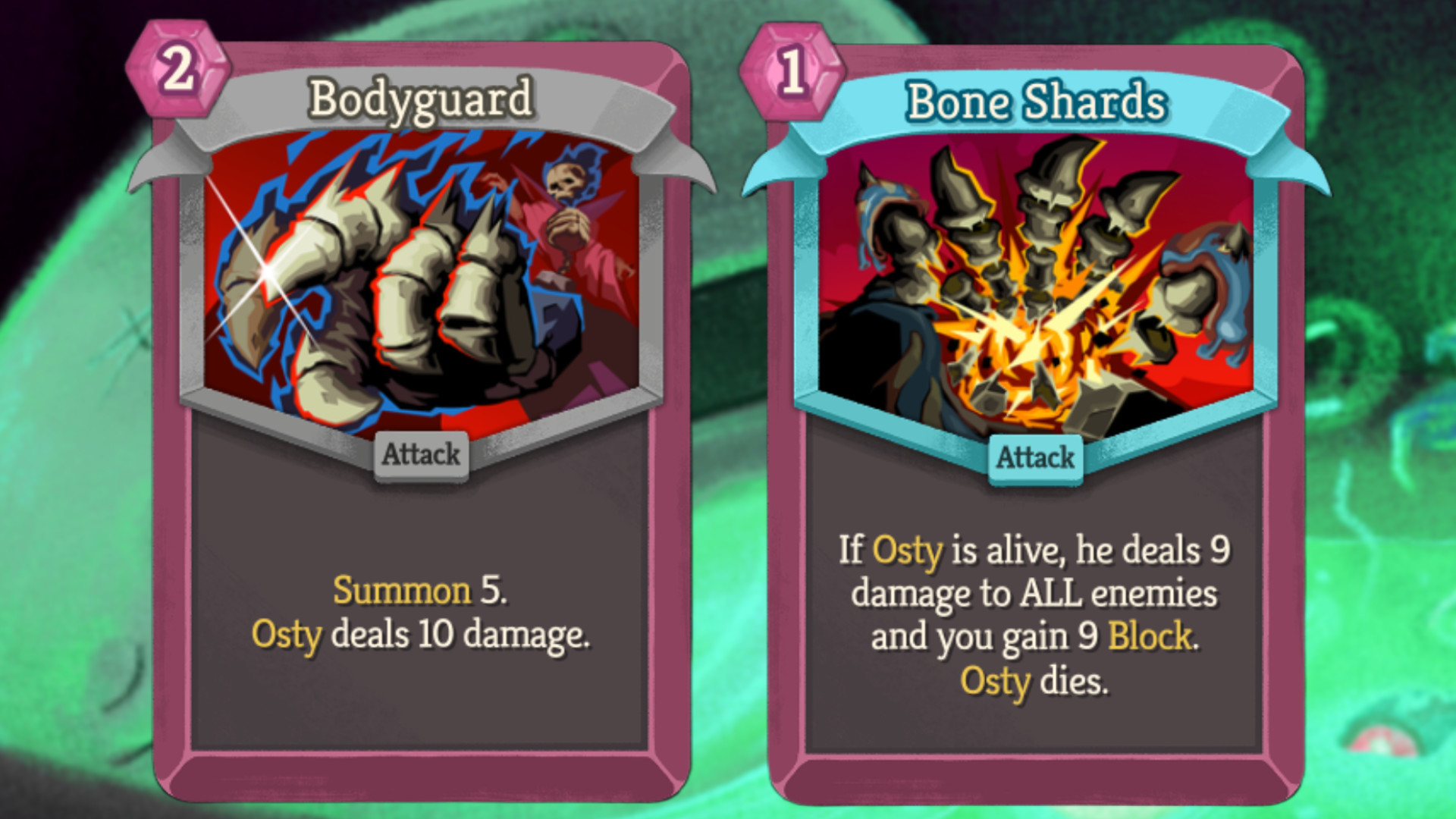
The Necrobinder is a fragile spellcaster who starts with lower HP than every other character. Her defining feature is Osty, a reanimated skeletal hand that acts as a companion with his own HP pool. Osty can attack, absorb damage, and die and be resummoned. She also introduces two completely new mechanics: Doom and Souls.
Doom Stacking Build
Doom is the Necrobinder’s signature debuff. It works differently from Poison: Doom stacks do not tick down over time, but when an enemy’s current HP drops to or below their Doom stacks, they instantly die. This means Doom and regular damage work together rather than competing.
Core cards: Blight Strike (deals 8 damage and applies Doom equal to the damage dealt), Negative Pulse and No Escape for Doom application, Reaper Form (a power that inflicts Doom based on your attack damage). Fear and Putrefy apply Vulnerable, which amplifies both your damage and your effective Doom threshold.
How it works: Deal damage to lower an enemy’s HP while simultaneously stacking Doom. Once their HP meets the Doom threshold, they drop dead regardless of any remaining HP or healing abilities. Against high-HP enemies, combine Vulnerable with heavy Doom application to reach the kill threshold faster. Reaper Form is the endgame power that makes every attack also stack Doom.
Key relics: Osty’s Bound Phylactery (starting relic, summons Osty) provides a damage sponge while you set up. Bone Flute helps with blocking. The Necrobinder is so fragile that any relic providing passive Block or HP recovery is valuable.
Soul Cycle / Exhaust Build
Souls are zero-cost token cards that draw 2 cards and then exhaust. They are generated by other Necrobinder cards and act as a draw engine that thins itself. The exhaust build uses Soul generation to cycle your entire deck rapidly.
Core cards: Haunt (deals 6 damage every time you play a Soul), Seance and Dirge for Soul generation, Scythe (permanently gains +3 to 4 damage every time you play it, synergizes with exhaust recovery), and Sleight of Flesh for card manipulation. Neurosurge grants 3 extra energy and 2 card draw but applies 3 Doom to yourself each turn.
How it works: Generate Souls through your cards, play them to draw through your deck, and trigger Haunt for passive damage on every Soul played. Scythe scales permanently across the entire run, so picking one up early maximizes its value. The goal is to thin your deck down to 15 to 20 cards where you draw your best cards every single turn.
Key relics: Anything that rewards exhausting cards. Osty also plays a role here as a defensive layer while you focus on cycling. Reanimate (+20 HP to Osty) and Bodyguard keep him alive as your shield.
When to pivot: If you are finding Osty-buffing cards like Unleash (Osty deals damage equal to his HP) and Reanimate but not many Soul generators, lean into a Summoner build instead. Stack Osty’s HP high and use Unleash as your primary damage source while Osty tanks hits.
⚡ Early Access note: Slay the Spire 2 is in active development. Card stats, relic effects, and balance will change as MegaCrit pushes updates. The archetypes and strategies in this guide reflect the launch version. We will update this guide as the meta evolves.
Frequently Asked Questions
Which character is the easiest for beginners in Slay the Spire 2?
The Ironclad. He heals 6 HP after every combat through his Burning Blood relic, which gives you room to make mistakes. His Strength build is also the most straightforward archetype in the game: stack Strength, play multi-hit attacks, win.
What is the strongest character in Slay the Spire 2 right now?
The Silent with a Sly Discard build has the highest damage ceiling in the current Early Access version. Her ability to play multiple cards for free through the Sly keyword gives her turns that no other character can match. That said, she has no healing and a steep learning curve.
How many cards should my deck have in Slay the Spire 2?
Aim for 25 to 30 cards. Smaller decks draw key cards more consistently. Remove Strikes and Defends at every opportunity, especially after Act 1 when they become dead draws compared to your build-specific cards.
Can you play Slay the Spire 2 in co-op?
Yes. Slay the Spire 2 supports online co-op for up to 4 players. Each player picks a character, and the team votes on map paths. Knocked-out players sit out for the rest of that combat but return for the next fight. Co-op has its own multiplayer-specific cards and team synergies. See our co-op guide for team compositions and strategy.
Should I skip Slay the Spire 1 and go straight to Slay the Spire 2?
You can. Slay the Spire 2 is a standalone game with no story continuity. However, the original teaches core deckbuilding principles that directly transfer to the sequel. If you want a cheaper way to learn the fundamentals before jumping into the harder sequel, the original is still excellent.
Gear for the Climb
Slay the Spire 2 runs great on low-end hardware, which makes it a perfect fit for handheld play. Roguelike runs are short enough to squeeze in anywhere, and co-op means you might want a proper controller for couch sessions.

Valve Steam Deck OLED 512GB
Roguelikes are made for handheld play. Run Slay the Spire 2 anywhere.

8BitDo Ultimate 2 Controller
Comfortable for long sessions. Works with PC, Steam Deck, and Switch.
Prices on gaming peripherals and accessories change constantly. Berry Finds tracks real-time Amazon deals across thousands of products so you can grab gear at the lowest price.
Summary
Slay the Spire 2 is harder than the original, but the builds above give you a clear path through the Spire with any character. Ironclad’s Strength scaling and Exhaust cycling are the most reliable for new players. Silent’s Sly Discard engine is the current ceiling for experienced players. Defect offers the choice between passive Orb scaling and aggressive Claw spam. The Regent requires patience and precise timing with Stars and the Sovereign Blade. And the Necrobinder rewards players who can manage Osty, stack Doom, and cycle Souls without getting killed by their own fragility. If you have mastered every archetype and want something new, our list of the best games like Slay the Spire covers 10 roguelike deckbuilders worth your next run.
The most important takeaway applies to every character: do not force a build. Read what the Spire offers you in card rewards and relics, stay flexible through Act 1, and commit to an archetype once you have enough pieces to make it work. The best build is always the one your run gives you. Our Wanderburg best builds guide applies the same rule to rolling castle modules. Roguelikes like this are also ideal for short sessions on a Steam Deck, where you can knock out a run or two between other things.
If you are just getting started, our Slay the Spire 2 beginner guide covers character overviews, co-op basics, and first-run tips. For fans of deck-building roguelikes in general, check out our Fairy Tail Dungeons beginner guide for another take on the genre.
And if tower-climbing action is more your speed than card draws, our Sephiria weapons and builds guide ranks all six branches of the new 1.0 release from the Dungreed team.