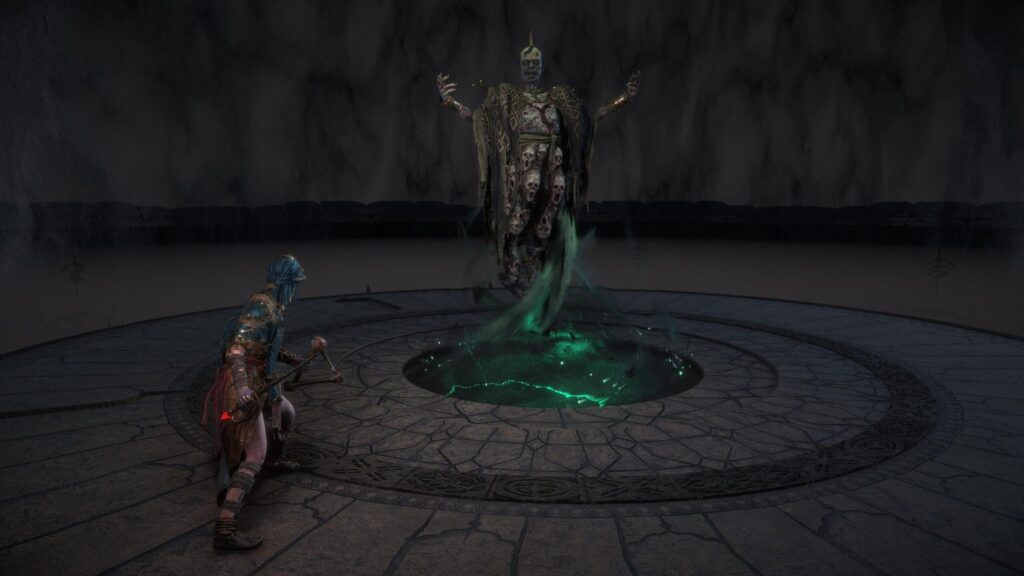
The PoE Coin of Desecration twists a Maraketh unique item into its Afarud form, corrupting it and adding a corrupted implicit modifier in the process. It is the rarest of the five djinn coins in the Mirage league because it only drops from Beyond monsters and Beyond bosses inside Mirage areas, not from standard Mirage encounters. This guide covers the drop source, the Restoration and Desecration reroll loop, and every Afarud unique pair so you know which items deserve a coin. If you want the full picture of all five coin types first, start with our djinn coins guide.
Key Takeaways
- What it does: converts a restored Maraketh unique into its Afarud counterpart, corrupts it, and guarantees a corrupted implicit modifier.
- Where it drops: Beyond monsters and the Beyond bosses K’tash, Ghorr, and Beidat inside Mirage areas. Standard Mirage encounters drop the other four coins, not this one.
- The conversion loop: a Coin of Restoration turns an Afarud unique back into its Maraketh form and randomizes its stats, then a Coin of Desecration converts it forward again with a corrupted implicit.
- Five valid targets: Khatal’s Geyser, Skysunder, The Flame of Hope, The Sacred Chalice, and Solerai’s Radiance, each turning into a different Afarud unique.
- Foulborn carries over: desecrating a Foulborn Maraketh unique keeps the Foulborn status on the resulting Afarud item.
What the Coin of Desecration Does
The Coin of Desecration is a currency item from the Mirage league (3.28) with a stack size of 10 and a drop level of 68. Right click the coin, then left click a valid Maraketh unique item. The item transforms into its Afarud counterpart, becomes corrupted, and gains a corrupted implicit modifier. The implicit is guaranteed, which is the whole appeal: a normal Vaal Orb gamble can brick an item, while the coin always pays out an implicit on a unique you chose to convert.
Two details matter before you spend one. First, the coin only works on the five restored Maraketh uniques. You cannot point it at a Mageblood and hope. Second, the conversion changes the item’s identity. Skysunder stops being an ignite sword and becomes Fleshrender, a poison sword. You are not adding an implicit to the item you have. You are trading it for its darker twin, with an implicit attached.
One more rule: if the Maraketh unique is Foulborn, the resulting Afarud unique stays Foulborn after the conversion.
How to Farm the PoE Coin of Desecration
The coin drops from Beyond monsters and Beyond bosses (K’tash, Ghorr, and Beidat) in a Mirage area. That restriction is the entire farming strategy. Mirage encounters alone will shower you in Coins of Restoration, Power, Skill, and Knowledge, but Desecration needs Beyond present inside the Mirage itself.
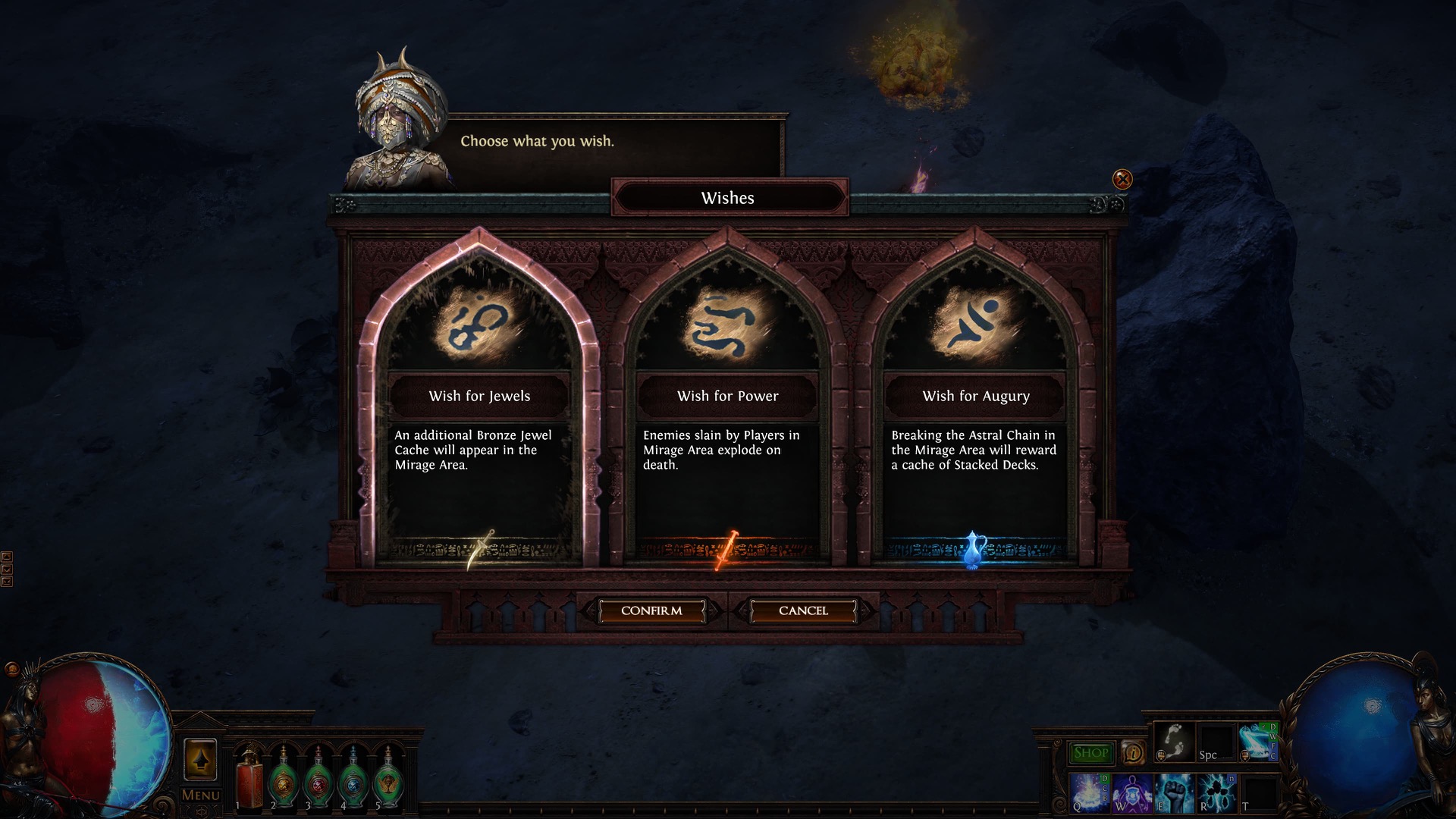
Mirages inherit your map setup. The scarabs, map modifiers, and Atlas passive points active on the map all apply inside the Mirage too. That gives you a simple recipe:
- Spec Beyond on your Atlas tree or run Beyond scarabs. Beyond has no base chance to appear in maps, so without Atlas passives or a scarab there are no Beyond monsters to drop the coin at all.
- Run Beyond scarabs on every map with a Mirage. The Mirage copies the scarab effects, so the investment counts twice.
- Kill packs close together inside the Mirage. Beyond attracts demons when you slay enemies close together, so tight pack clusters spawn more of them.
- Prioritize the Beyond bosses. K’tash, Ghorr, and Beidat are the headline drops. They can also drop the Volatile Vaal Orb, a separate Mirage currency that rerolls or destroys unique items.
For map choice, open layouts with dense packs serve Beyond farming well. Our Mirage farming maps guide ranks the strongest layouts for this kind of strategy.
⚡ Quick tip: Honoured Incubators add an incubated coin item to a piece of gear, which can hatch into any of the five djinn coins or Gold. They are a slow but passive secondary source if your Beyond setup is still coming together.
The Restoration and Desecration Loop
The two unique-item coins form a cycle, and understanding it is what separates spending coins from wasting them.
- An Afarud unique drops from Afarud monsters in a Mirage. It can also drop as Foulborn from Mirage Breaches.
- A Coin of Restoration turns it into its Maraketh form. This randomizes the item’s stat rolls, so a badly rolled drop gets a fresh chance.
- A Coin of Desecration turns the Maraketh form back into the Afarud version. The item comes back corrupted with a guaranteed corrupted implicit.
A full pass is a double reroll: stats randomize on restoration, and the implicit rolls on desecration. One caveat: desecration corrupts the item, and no official source documents whether a corrupted Afarud unique still counts as a valid target for the Coin of Restoration. Before cycling an expensive item, test the second restoration on a cheap pair like the level 24 belts. Desecration coins are the scarce half of the pair either way, so they set the cost of every conversion.
This also means the order of operations matters when an Afarud unique drops with good rolls. Restoring it randomizes those rolls. If the Afarud version already rolled well and you want the Afarud version, leave it alone or corrupt it through other means. Only enter the loop when you want the other form, or when the rolls are bad enough that a randomization is worth the risk.
Every Maraketh and Afarud Pair
Five item pairs exist as of June 2026, and each one is really two different items sharing a base. Here is the full mapping, then a closer look at what each form does.
| Restored Maraketh Form | Afarud Form | Base Item | Level |
|---|---|---|---|
| Khatal’s Geyser | Khatal’s Weeping | Lapis Amulet | 56 |
| Skysunder | Fleshrender | Exquisite Blade (2H Sword) | 70 |
| The Flame of Hope | The Bane of Hope | Maraketh Bow | 71 |
| The Sacred Chalice | The Desecrated Chalice | Coronal Maul (2H Mace) | 69 |
| Solerai’s Radiance | Saresh’s Darkness | Chain Belt | 24 |
Skysunder and Fleshrender
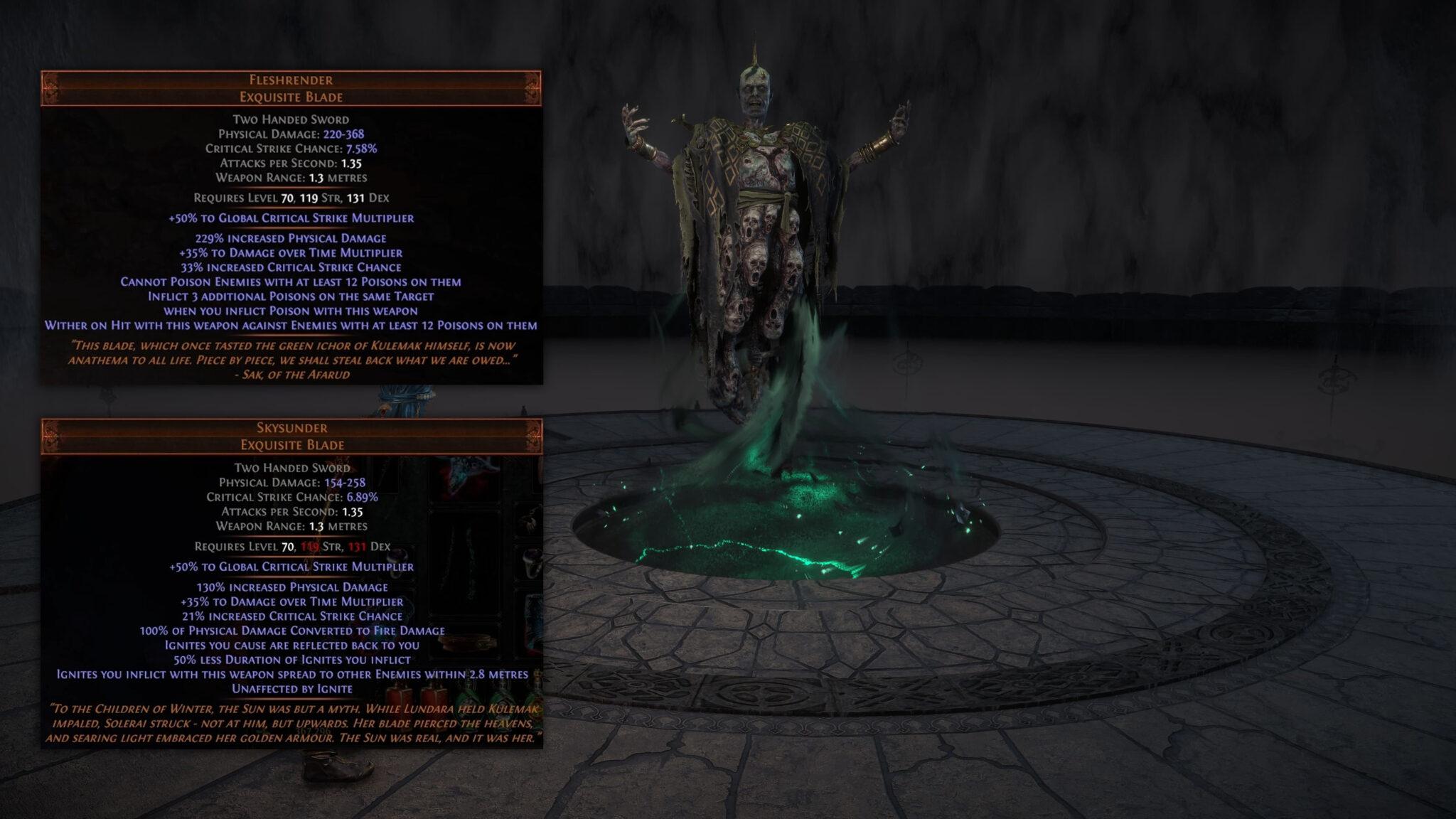
The flagship pair. Fleshrender is a poison crit sword: it inflicts 2 to 3 additional poisons per poisoning hit, caps enemies at 12 poisons, and applies Wither on hit against anything at that cap. With the base poison plus the extra stacks, you reach the 12-poison ceiling in about three hits, at which point Wither piles up to 90% increased chaos damage taken. Perfect Agony builds on Assassin, Pathfinder, and Trickster get the most out of it.
Skysunder converts 100% of physical damage to fire, reflects your ignites back to you while leaving you Unaffected by Ignite, and spreads your ignites to enemies within 2.8 metres. The self-ignite trick means the ailment exists on your character without dealing damage, which feeds any mechanic that cares about you being ignited. Built-in proliferation saves a support socket. Chieftain and Elementalist ignite builds are the natural homes. The trade-off is 50% less ignite duration, so you want high hit frequency.
Coin verdict: this is the pair where the coin sees the most use, because both forms have real build demand. Whichever form drops for you, there is a market for the other.
Khatal’s Geyser and Khatal’s Weeping
Khatal’s Geyser is a mana amulet. It blocks life flasks, gives 55 to 70 maximum mana, grants Arcane Surge during any mana flask effect, and applies flask effect modifiers to your Arcane Surge at 200 to 250% of their value. Mana flask effects also stop expiring when your unreserved mana fills. Spellcasters who stack flask effect get a permanent, supercharged Arcane Surge out of it.
Khatal’s Weeping flips to the life side: 80 to 100 maximum life, no mana flasks allowed, and a mechanic that drains a life flask to 50% of its charges on each non-channelling attack, granting +2% damage over time multiplier per charge removed. While on low life, life flasks regain 3 to 6 charges every 3 seconds. It is a low-life DoT attacker’s amulet with a flask economy to manage.
Coin verdict: convert based on archetype, not rolls. A caster holding Weeping or a DoT attacker holding Geyser is the exact situation the coin exists for.
The Flame of Hope and The Bane of Hope
The Flame of Hope is a fire attack bow with 180 to 230 to 310 to 360 added fire damage, 14 to 18% attack speed, and Fire Exposure on hit against enemies carrying 5 Cinderflame, applying -25% to fire resistance. It triggers Level 20 Cinders while equipped. The Bane of Hope goes physical instead: 90 to 130% increased physical damage, +28 to 35% physical damage over time multiplier, flat physical, impale chance, and a Level 20 Tears of Rot trigger.
Coin verdict: fire bow builds versus physical DoT bow builds. The two forms barely compete for the same character, so the coin is a clean archetype swap here too.
The Sacred Chalice and The Desecrated Chalice
Both maces share the same physical damage, area of effect, and crit lines, plus a shared mechanic: gain a flask charge when you deal a critical strike. The difference is the payoff. The Sacred Chalice grants 20 to 40% of physical as extra cold, fire, or lightning damage for each matching elemental flask (Sapphire, Ruby, Topaz) used recently, so a three-flask setup stacks all three. The Desecrated Chalice condenses it into one line: 40 to 75% of physical as extra chaos damage if you used an Amethyst Flask recently, with 0.4 to 0.5% of chaos damage leeched as life.
Coin verdict: Sacred has the higher ceiling if you commit three flask slots; Desecrated does more with one. Crit-stacking slam builds will want to math out their flask tolerance before spending the coin.
Solerai’s Radiance and Saresh’s Darkness
The level 24 belts. Solerai’s Radiance carries fire resistance, ignite duration, a Level 20 Blazing Glare skill, and a defensive line that stops blinded enemies from inflicting damaging ailments. Saresh’s Darkness swaps to chaos resistance, poison duration, Level 20 Caustic Retribution, and poisoned enemies losing the ability to crit you.
Coin verdict: these are leveling and niche-build items rather than endgame chase pieces. Spending a scarce Desecration coin on a belt pair this cheap rarely beats just buying the form you want, unless you are after a specific corrupted implicit on one.
Is the Coin Worth Using?
Three situations justify a Coin of Desecration. You hold the Maraketh form and your build wants the Afarud form, you want a guaranteed corrupted implicit on one of the five Afarud uniques without Vaal Orb risk, or you are converting a high-value pair like Skysunder and Fleshrender. Outside those cases, the coin usually earns more sold to someone who is.
On pricing: the coin’s Beyond-only drop restriction keeps supply low relative to the other four djinn coins, and prices move with league economy swings. Check the live numbers on poe.ninja’s djinn coins page before buying or selling a stack. Early in an economy, badly rolled Afarud drops trade cheap, which makes them good loop fodder if coins are also cheap.
If your interest in djinn coins runs toward the gem side instead, the Coin of Power guide covers how the imbuing coins corrupt level 20 skill gems with support effects.
Frequently Asked Questions
What does the Coin of Desecration do in PoE?
The Coin of Desecration twists a restored Maraketh unique item into its Afarud form, corrupting it and adding a guaranteed corrupted implicit modifier. Right click the coin, then left click a valid Maraketh unique. It only works on the five restored Maraketh uniques from the Mirage league.
Where does the Coin of Desecration drop?
It drops from Beyond monsters and the Beyond bosses K’tash, Ghorr, and Beidat inside Mirage areas. Standard Mirage encounters do not drop it, which makes it rarer than the other four djinn coins. Honoured Incubators can also hatch into a random coin.
What is the difference between the Coin of Desecration and the Coin of Restoration?
They run in opposite directions. The Coin of Restoration turns an Afarud unique back into its restored Maraketh form and randomizes the item’s stats. The Coin of Desecration turns a restored Maraketh unique into its Afarud form, corrupts it, and adds a corrupted implicit.
Can you reroll the corrupted implicit from a Coin of Desecration?
The documented path is restoring the Afarud unique with a Coin of Restoration, which randomizes its stats, then desecrating it again for a new corrupted implicit. Official sources do not confirm whether restoration works on an item after desecration corrupts it, so test the cycle on a cheap unique before spending coins on an expensive one.
Which Afarud uniques are worth a Coin of Desecration?
Fleshrender is the most common target because poison crit builds actively want it and its Maraketh form, Skysunder, serves a completely different ignite archetype. Khatal’s Weeping and The Bane of Hope also see use. The level 24 belt pair is usually cheaper to buy outright than to convert.
How much is a Coin of Desecration worth?
Its value tracks its scarcity as the only Beyond-restricted djinn coin, and it shifts with the league economy. Check poe.ninja’s djinn coins page for live Mirage league prices rather than relying on a fixed number.
Gear for Long Mapping Sessions
Beyond farming is a volume game. You are running map after map, watching for purple shimmer, and reading item tooltips deep into the night. A chair that holds up past hour three, light that keeps tooltip text readable without searing your eyes, and a mouse surface big enough for constant repositioning all pull their weight. As of June 2026, these three are solid deals.

GTPLAYER Gaming Chair
Footrest, removable lumbar support, and a 90 to 155 degree recline for marathon map sessions.

YEELIGHT Monitor Light Bar RGB
350 lumen no-glare screen bar with stepless dimming, so late-night tooltips stay readable.

Glorious GMP 2 XL Mouse Pad
Spill-proof 18 by 14 inch surface with anti-fray edges, built for thousands of map clicks.
Between mapping sessions, Berry Finds tracks real-time Amazon deals on thousands of everyday products across home, kitchen, beauty, and more, so the stuff you buy outside of gaming never costs full price.
Summary
The Coin of Desecration converts restored Maraketh uniques into corrupted Afarud forms with a guaranteed implicit, drops only from Beyond monsters and bosses inside Mirage areas, and pairs with the Coin of Restoration to form a stat-and-implicit reroll loop. Spec Beyond on your Atlas, run Beyond scarabs on Mirage maps, and save your coins for the pairs where both forms hold value. For the rest of the Mirage league’s currency systems, the djinn coins guide and the Coin of Power guide cover the other four coins.