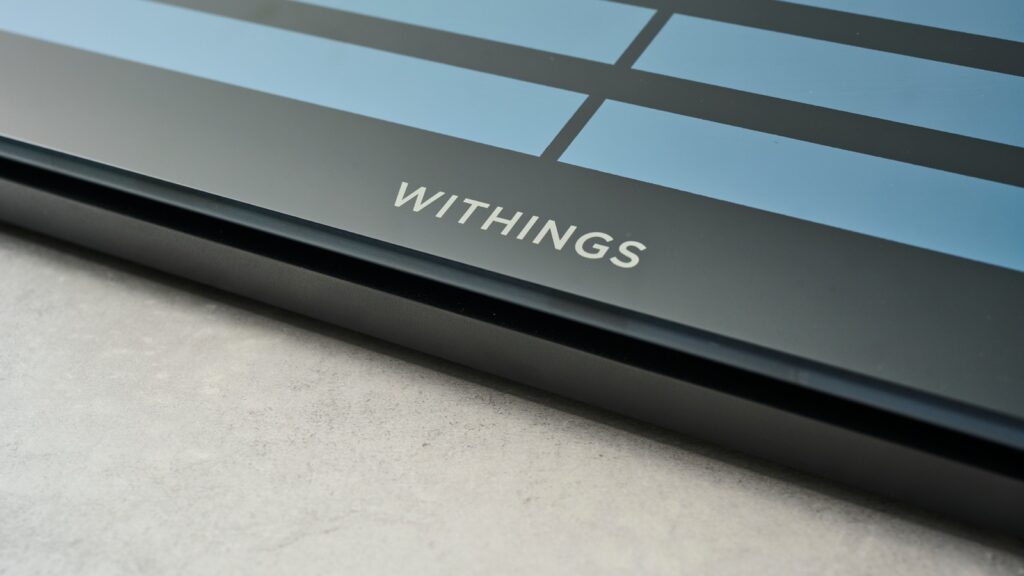
Body composition scales promise to tell you everything from your body fat percentage to your muscle mass, bone density, and visceral fat levels. The problem? Most of them are measuring the same thing in the same way, and the price range runs from $25 to $500. That spread is wild for products that all use bioelectrical impedance analysis (BIA) to estimate what’s going on inside you.
After comparing nine of the most recommended body composition scales across every price bracket, here’s what’s worth your money and what’s just paying for a fancier app.
Key Takeaways
- Value pick: The Eufy Smart Scale P2 Pro ($50) gives you 16 metrics, Wi-Fi syncing, and a 3D body model for less than most scales charge for weight alone
- Accuracy reality check: Consumer BIA scales are 3-8 percentage points off from DEXA scans for body fat estimates, so track trends over time instead of fixating on any single reading
- Premium accuracy: Scales with hand electrodes like the Hume Health Body Pod ($229), InBody H20 ($299), and Withings Body Scan ($500) measure your arms, legs, and torso separately for more reliable numbers
- Ecosystem matters: If you already use Garmin Connect or Apple Health, pick a scale that syncs natively rather than chasing slightly better specs
- FSA/HSA eligible: Most body composition scales qualify for FSA/HSA reimbursement, which can cut the cost significantly
Quick Comparison
| Scale | Price | Metrics | Connectivity | Tier |
|---|---|---|---|---|
| Renpho Elis 1 | $25 | 13 | Bluetooth | Budget |
| Wyze Scale X | $34 | 13 | Bluetooth | Budget |
| Eufy Smart Scale P2 Pro | $50 | 16 | Wi-Fi + Bluetooth | Mid-Range |
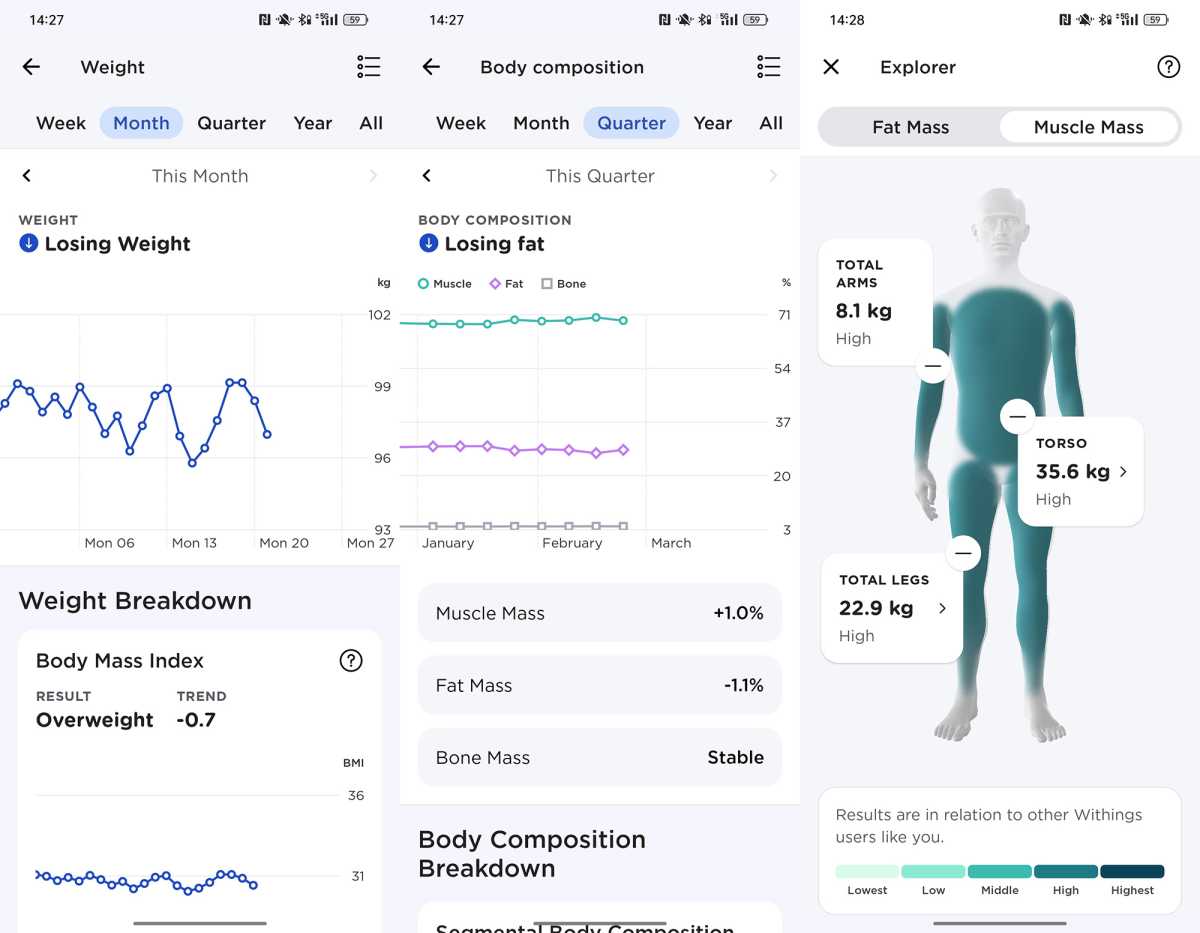
| Withings Body Smart | $130 | 9+ | Wi-Fi + Bluetooth | Mid-Range |
| Garmin Index S2 | $150 | 6 | Wi-Fi | Mid-Range |
| Withings Body Comp | $230 | 12+ | Wi-Fi + Bluetooth | Premium |
| Hume Health Body Pod | $229 | 45+ | Bluetooth | Premium |
| InBody H20 | $299 | 5+ | Bluetooth | Premium |
| Withings Body Scan | $500 | 17+ | Wi-Fi + Bluetooth | Premium |
Prices are approximate as of March 2026 and may vary. All scales listed are FSA/HSA eligible.
How Body Composition Scales Work
Every body composition scale on this list uses bioelectrical impedance analysis (BIA). The scale sends a small electrical current through your body and measures how quickly it returns. Fat tissue resists electricity more than muscle and water, so the scale uses that resistance data plus your height, age, and weight to estimate your body composition.
Here’s the honest part: consumer BIA scales are 3-8 percentage points off from DEXA scans (the clinical gold standard) when measuring body fat. A 2021 JMIR mHealth study found that several popular scales underestimated fat mass by 2-4 kg compared to DEXA. Hydration levels, time of day, and even what you ate recently can shift your readings.
That doesn’t make them useless. It means you should use them for tracking trends over weeks and months rather than obsessing over any single reading. Step on at the same time each day under the same conditions, and the direction of the trend line is reliable even if the absolute numbers aren’t clinical-grade.
Three things separate cheap scales from expensive ones:
- Number of frequencies: Budget scales use single-frequency BIA. Premium models like the Withings Body Scan use 3 frequencies, which gives more accurate readings across different tissue types.
- Number of electrodes: Foot-only scales measure from your feet up. Scales with hand electrodes (like the InBody H20) can measure your arms, legs, and torso separately.
- App quality: The hardware differences are smaller than you’d think. The real gap between a $25 and $200 scale is often the companion app’s design, data visualization, and health ecosystem integration.
Budget Picks (Under $50)
Renpho Elis 1
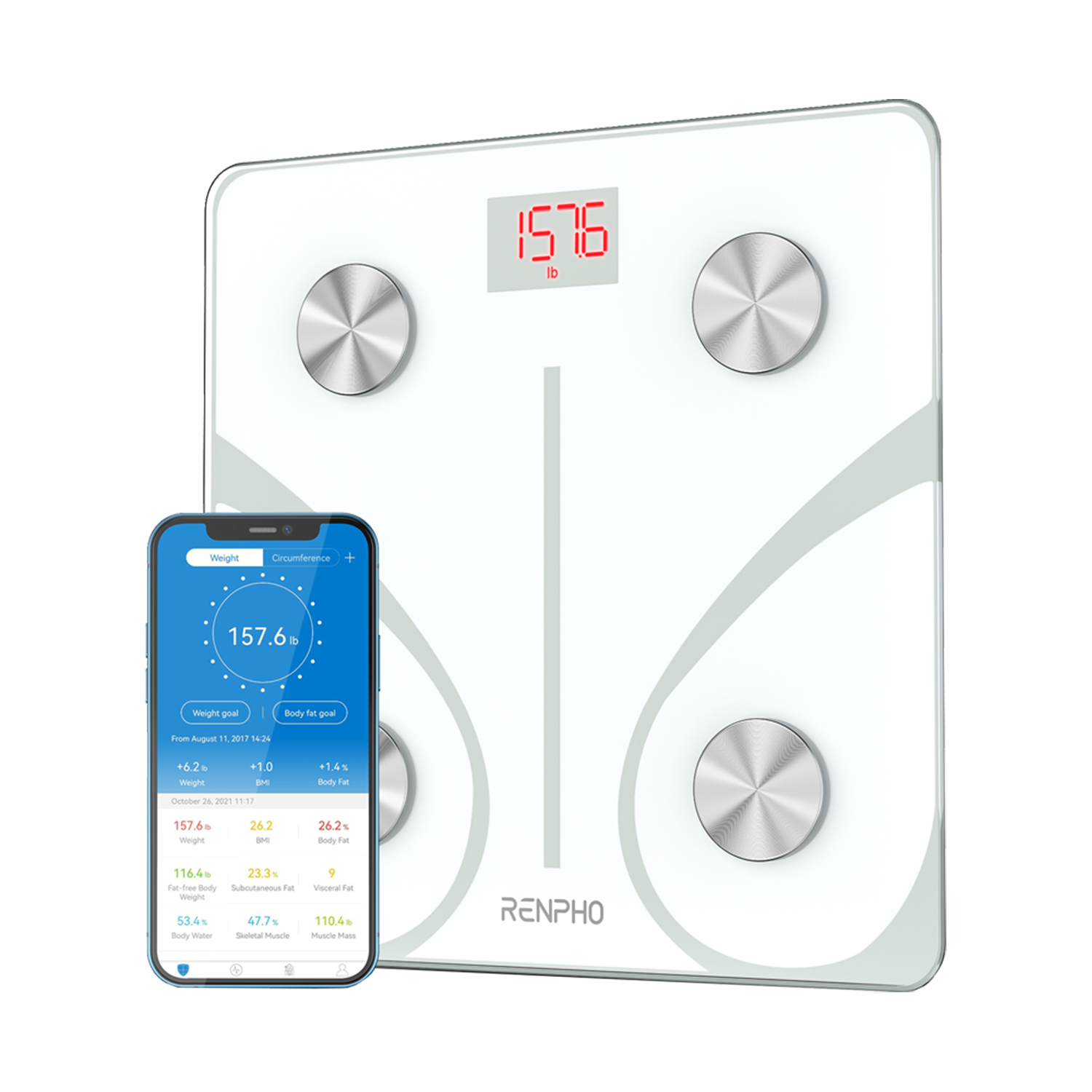
The Renpho Elis 1 is the entry point for body composition tracking and it’s surprisingly capable at $25. It measures 13 metrics including body fat percentage, muscle mass, bone mass, BMR, visceral fat, and metabolic age. Syncs via Bluetooth to the Renpho Health app, which also connects to Apple Health, Google Fit, Fitbit, and MyFitnessPal.
The Renpho app is well-designed and supports unlimited user profiles, so everyone in your household can track their own data. There’s also a baby weighing mode where you step on holding the baby and it calculates the difference. With over 73,000 Amazon ratings and a 400 lb capacity, this is the scale that’s brought body composition tracking to the mainstream.
The tradeoff is accuracy. Single-frequency, foot-only BIA at this price point gives rough estimates. It’s fine for watching the trend line move over months, but don’t compare the body fat number directly to a DEXA scan result.
Wyze Scale X
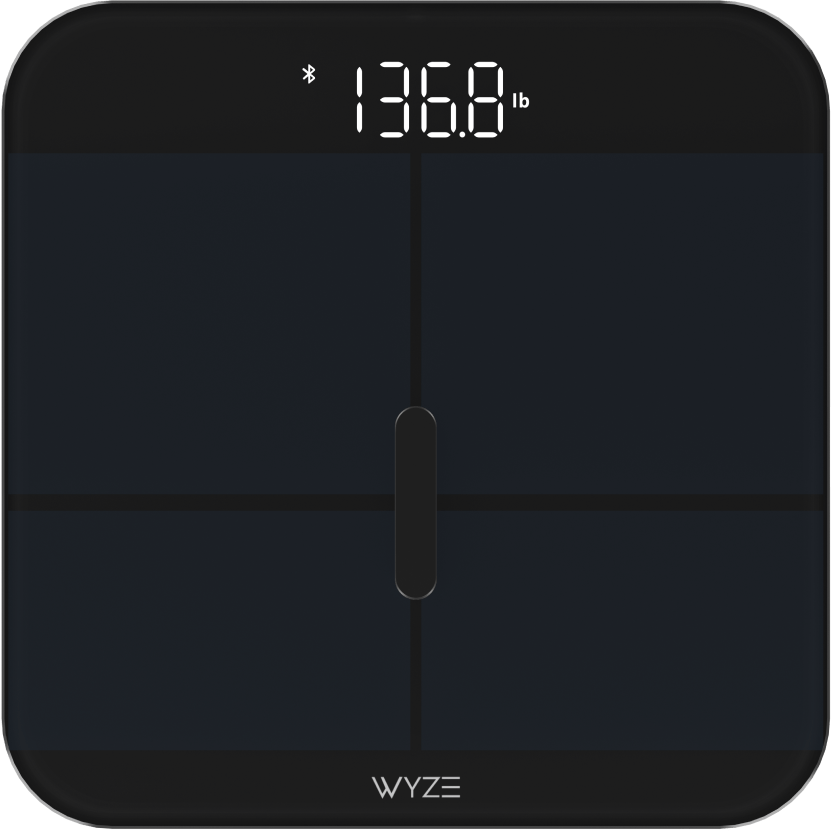
The Wyze Scale X matches the Renpho on metric count (13 measurements) but adds a built-in heart rate monitor and ITO-coated glass for $34. It also includes Baby, Pet, Luggage, and Pregnancy modes, which is a nice touch for a budget scale.
Garage Gym Reviews tested the Wyze Scale X against a larger BIA reference machine and found it underestimated muscle mass by about 10%. That’s within the expected error range for a budget scale, and the heart rate monitoring is a genuine bonus that most sub-$50 scales skip. It supports up to 8 users and runs on 4 AAA batteries.
The main downside is Bluetooth-only connectivity. You need your phone nearby to sync readings, and the Wyze app ecosystem isn’t as polished as Renpho’s or Eufy’s.
Mid-Range Picks ($50-$150)
Eufy Smart Scale P2 Pro
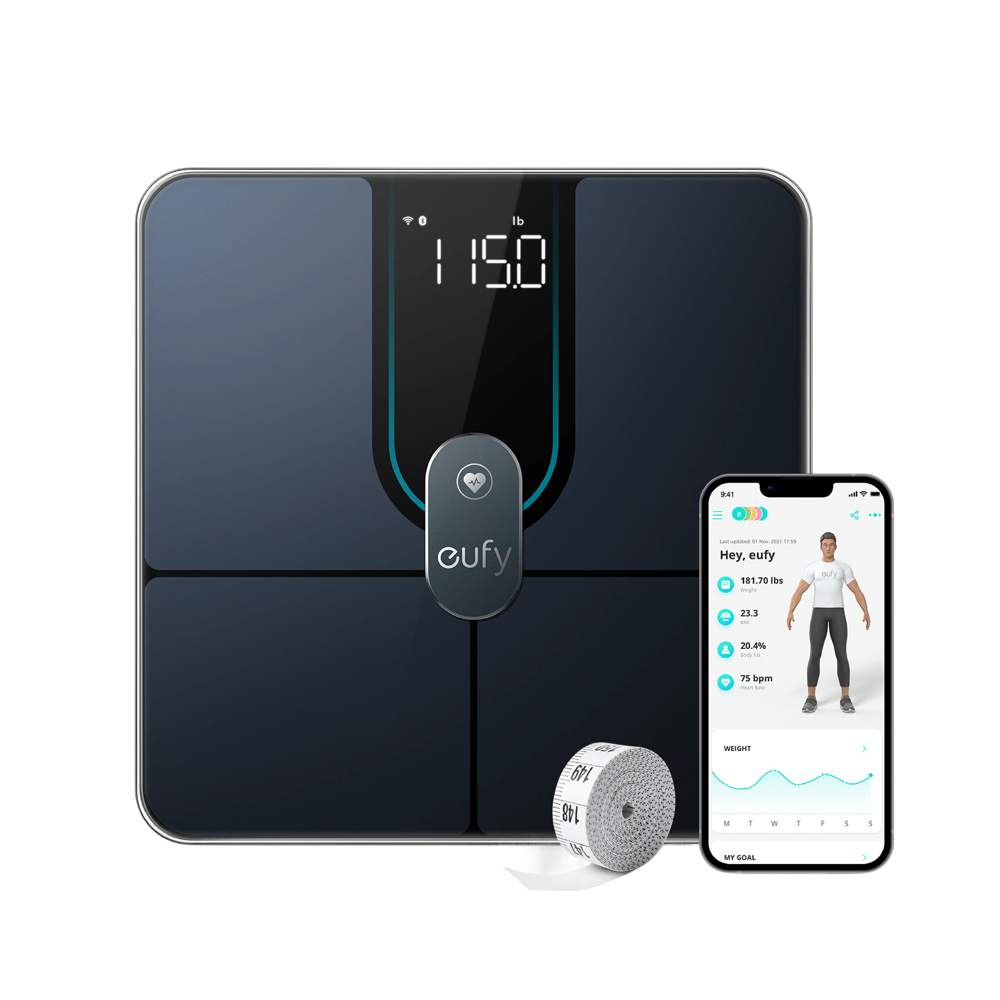
The Eufy Smart Scale P2 Pro is the sweet spot for most people. At $50, you get 16 body measurements, Wi-Fi syncing (so readings upload even without your phone nearby), a heart rate sensor, and a 3D Virtual Body Mode in the Eufy app that maps your measurements onto a visual model.
Backed by Anker (known for reliable consumer electronics), the P2 Pro includes a measuring tape in the box and offers lifetime customer support. It syncs with Apple Health, Google Fit, and Fitbit. Garage Gym Reviews found that weight and body fat readings were “pretty accurate” compared to reference scales and body scans.
The ITO coating on the glass surface means the entire platform is a sensor, so you don’t need to hit specific foot positions. At $50, there’s very little reason to spend less unless you genuinely don’t need Wi-Fi connectivity.
Withings Body Smart
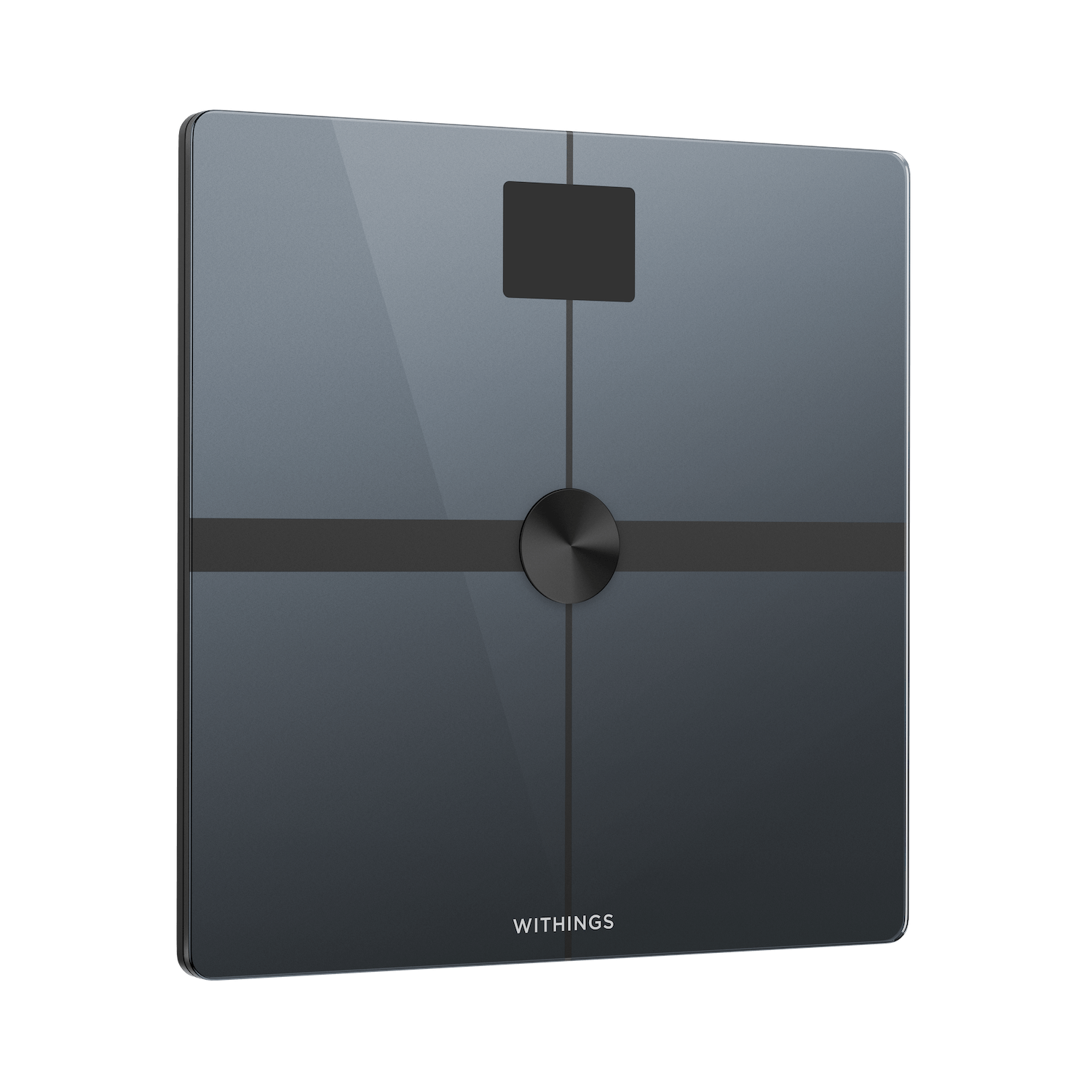
The Withings Body Smart is where you start paying for app quality and ecosystem polish. Withings invented the connected smart scale, and their Health Mate app is the most refined in the category. It uses 2-frequency BIA (most budget scales use single-frequency), which gives slightly better accuracy for body fat and muscle mass estimates.
The Body Smart measures weight, body fat, water percentage, muscle mass, bone mass, visceral fat, BMR, BMI, and standing heart rate. It supports up to 8 users with auto-recognition (it knows who’s stepping on based on weight history), has a pregnancy tracker, and baby mode. The 2.8″ screen shows your data directly on the scale.
What you’re paying the premium for here is the Withings ecosystem. Health Mate syncs with Apple Health, Google Fit, and works with other health-focused desk setups. If you already own Withings products (watches, blood pressure monitors), this is the natural choice. If you don’t, the Eufy P2 Pro gives you more metrics for less than half the price.
Garmin Index S2
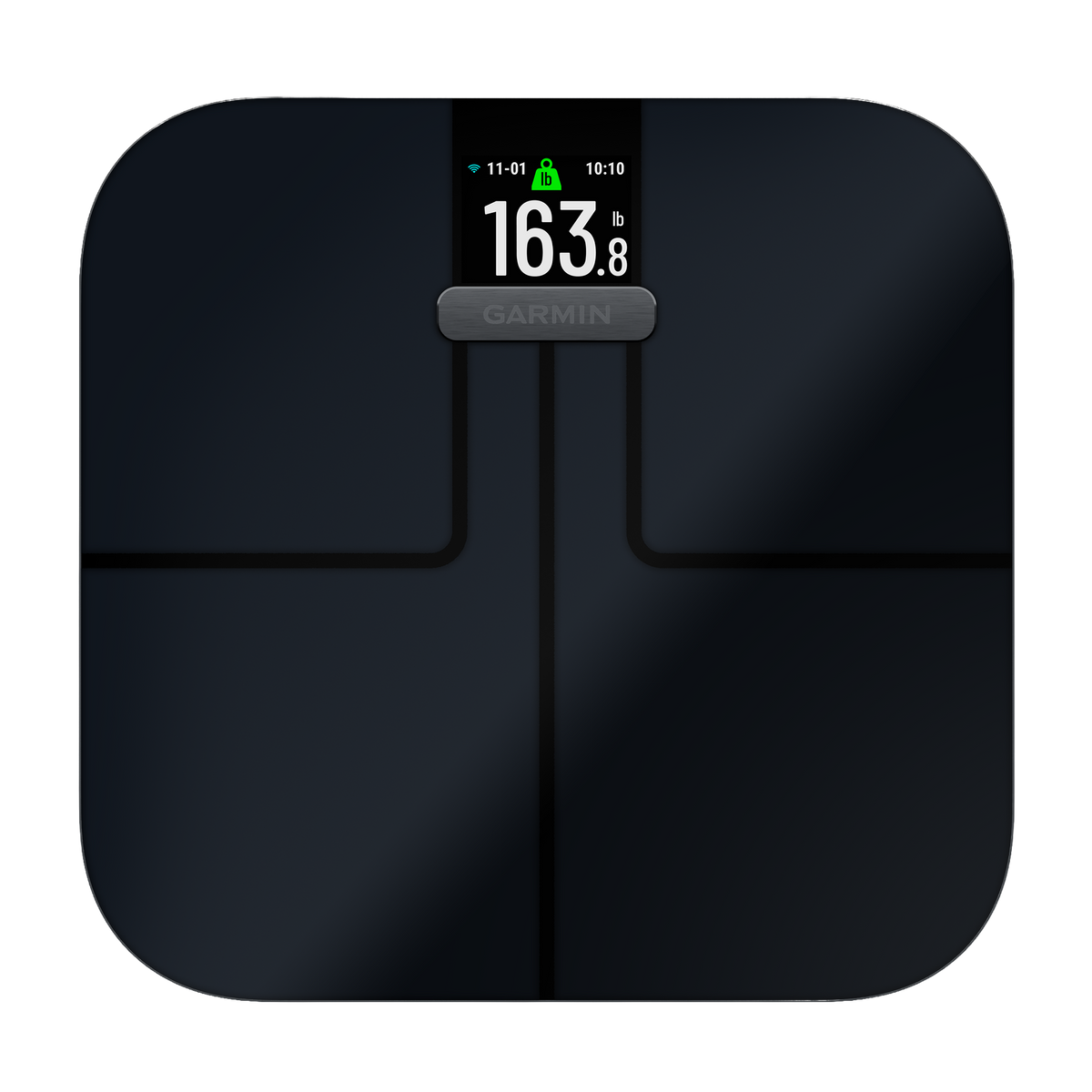
The Garmin Index S2 exists for one reason: Garmin Connect integration. If you wear a Garmin watch, your weight and body composition data flows directly into the same app that tracks your runs, sleep, and recovery. That single-ecosystem view is something no other scale can offer Garmin users.
It measures weight, BMI, body fat, skeletal muscle mass, bone mass, and body water. The color display shows 9 days of trend data right on the scale, and it supports up to 16 users with auto-recognition. Wi-Fi connectivity means it syncs without your phone.
The catch: TrainerRoad forum users have noted that the Garmin reads about 4-5% higher for body fat compared to Tanita scales in gym settings. Garmin’s own documentation focuses on “precisely consistent” readings, which is another way of saying the absolute number might not match clinical tools, but the trend is reliable. If you’re not in the Garmin ecosystem, the Withings Body Smart offers better body composition features at a similar price.
Premium Picks ($200+)
Withings Body Comp
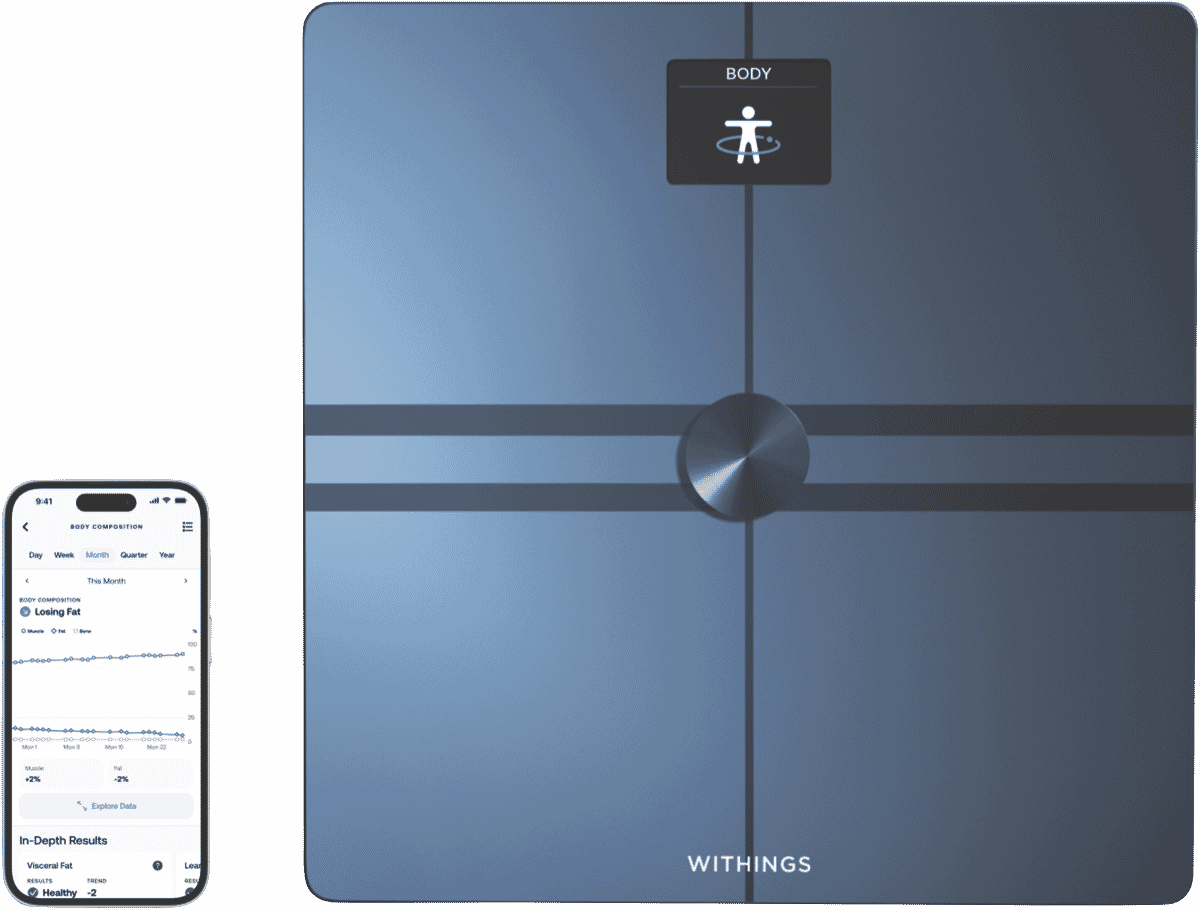
The Withings Body Comp takes everything from the Body Smart and adds vascular age assessment, electrodermal activity monitoring (a measure of nerve health), and richer on-device analytics with a 2.8″ high-res color screen. You also get 3 months of Withings+ premium instead of 1 month.
The vascular age metric is the standout. It estimates the stiffness of your blood vessels, which is a useful marker for cardiovascular health that most scales don’t even attempt to measure. The electrodermal activity sensor tracks sweat gland activity in your feet, which can indicate early signs of certain nerve conditions.
Whether these extra metrics justify the $100 premium over the Body Smart depends on how data-driven your health tracking is. For most people, the Body Smart covers enough. But if you’re serious about monitoring cardiovascular and metabolic health alongside body composition, the Body Comp is the only consumer scale offering these measurements.
Hume Health Body Pod
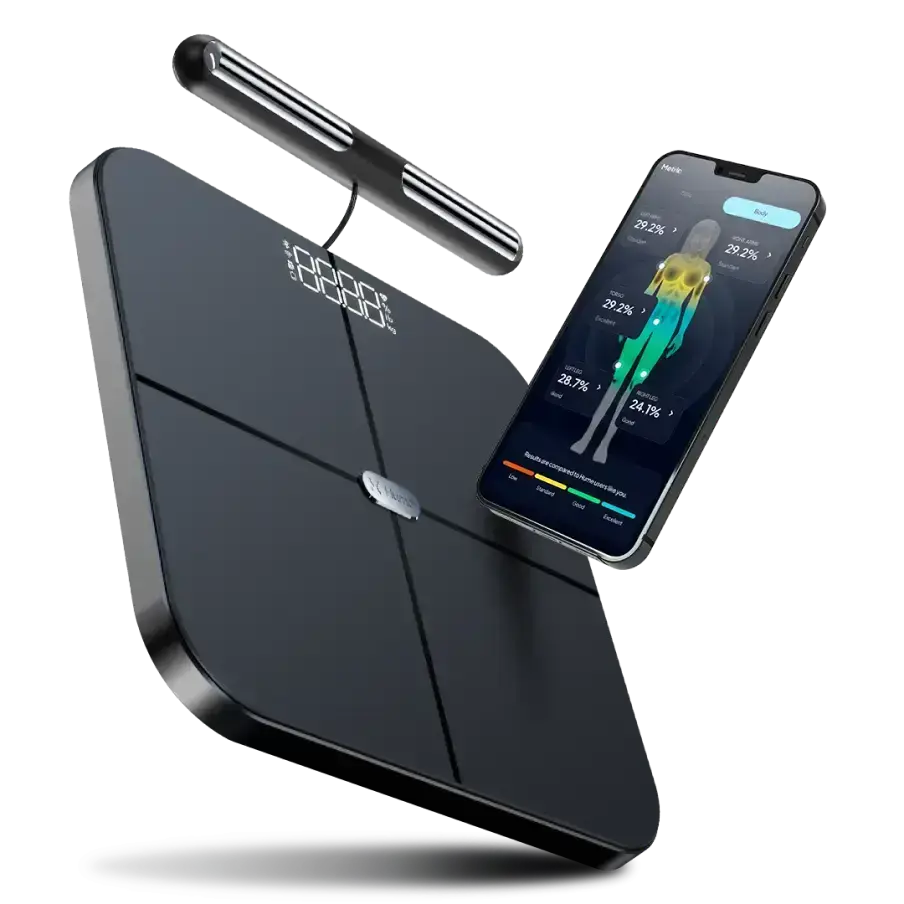
The Hume Health Body Pod uses 8-electrode multi-frequency BIA with a segmental handle to measure all five body zones: left arm, right arm, torso, left leg, and right leg. At $229 it undercuts the Withings Body Scan by nearly half while offering similar dual-point contact measurement. It tracks 45+ health metrics including body fat, skeletal muscle mass, visceral fat, bone density, metabolic age, and segmental fat distribution.
The handle-based approach is the same principle behind the InBody H20 and Withings Body Scan: sending current through your hands and feet creates a full-body circuit instead of just measuring your lower half. Hume claims their readings land within 2-3% of DEXA scan results based on an independent study, though as with any consumer BIA device, hydration and timing will affect individual readings. The rechargeable battery and 2.8″ display are nice touches, and it supports up to 24 user profiles.
The free companion app syncs with Apple Health, Google Health Connect, Fitbit, and Garmin. There’s also a $9.99/month premium tier for AI coaching and personalized health reports, which is a recurring cost to factor in. Some users have reported Bluetooth connectivity issues, and the app isn’t as mature as Withings Health Mate or the Eufy app. But if you want segmental analysis with the most metrics in the category without spending $500, the Body Pod is the most aggressive value play in the premium tier.
InBody H20
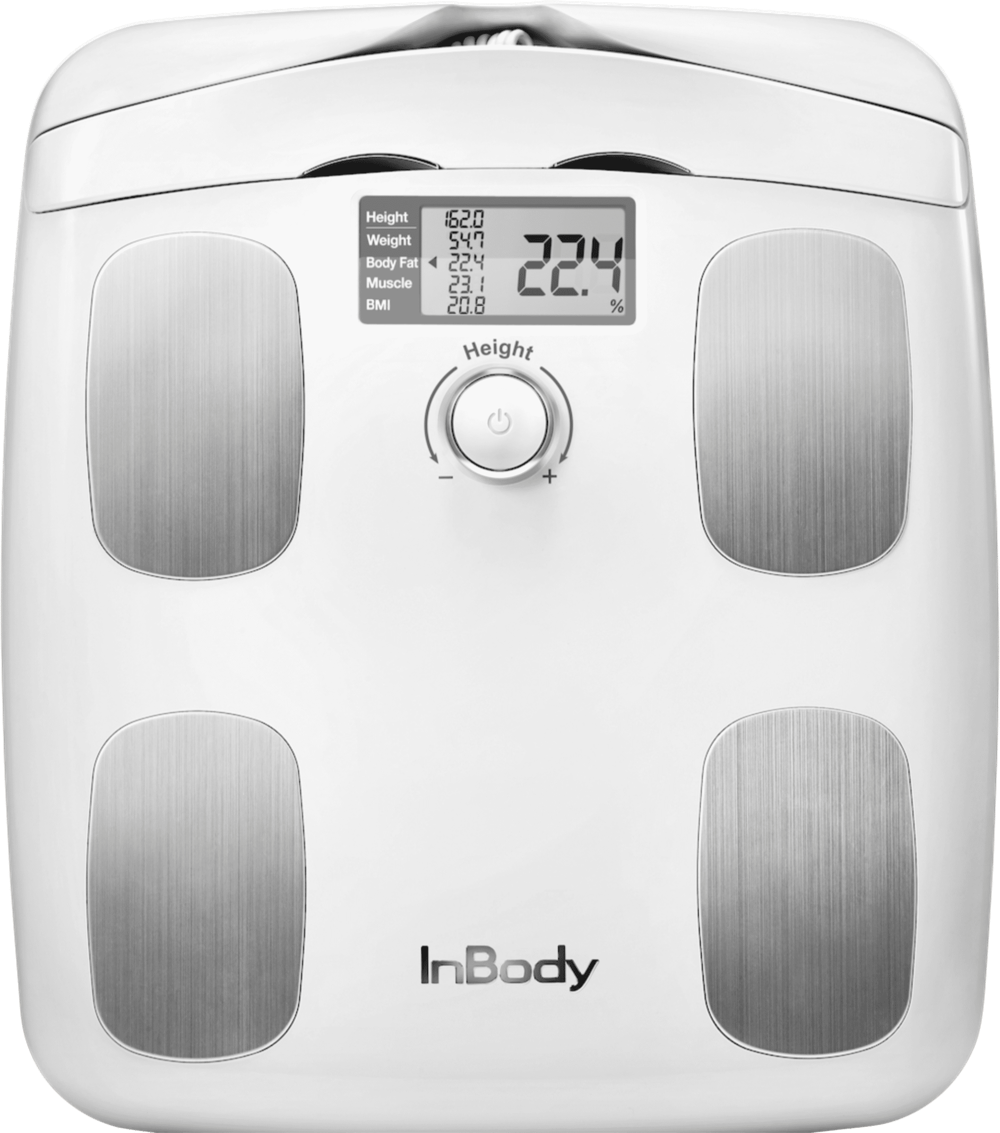
InBody is the brand you see in gyms, medical offices, and sports facilities. Their commercial analyzers cost $5,000+, and the InBody H20 brings that technology home at $299. The key difference from every other scale on this list: patented thumb electrodes that measure your upper body separately from your lower body.
Foot-only scales send the current up one leg and down the other, which means they barely measure your torso at all. The InBody H20’s thumb electrodes create a full-body circuit that measures arms, legs, and trunk independently. This is why gym-grade InBody machines have such a strong reputation for accuracy.
The tradeoff is the app experience. The InBody app is functional but not as polished as Withings Health Mate or even the Eufy app. It connects via Bluetooth (no Wi-Fi), and it measures fewer named metrics than cheaper scales. But the metrics it does measure are more reliable. If accuracy matters more than app design to you, this is the home scale to get.
Withings Body Scan
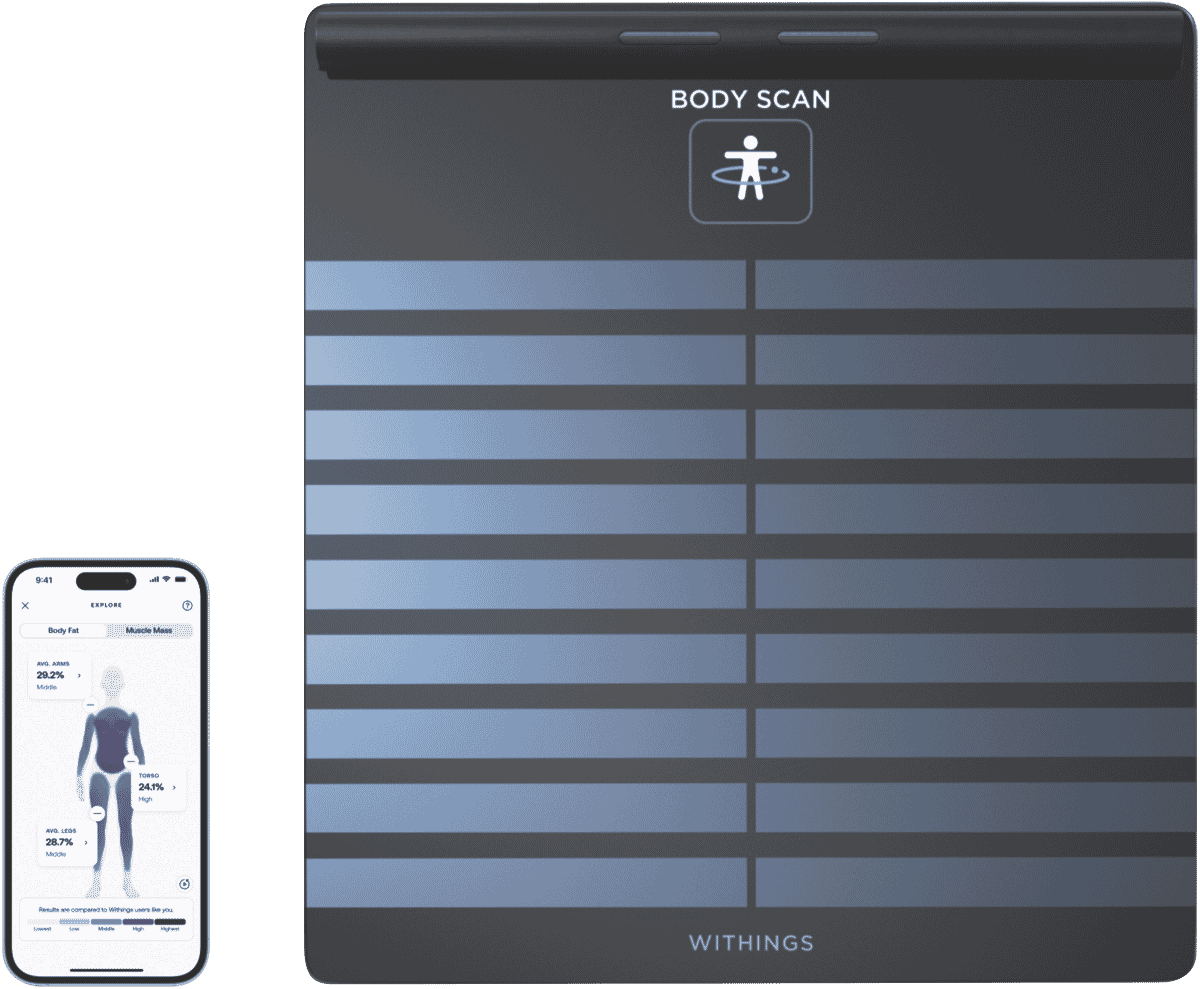
The Withings Body Scan is the most advanced consumer body composition scale available. It combines 3-frequency BIA, a retractable handle with 4 additional electrodes, an FDA-cleared 6-lead ECG, and segmental body composition analysis across 5 body zones (arms, legs, torso).
The segmental analysis is the headline feature. Instead of a single body fat number, you see fat and muscle mass broken down by arms, legs, and torso. That’s useful for spotting imbalances (like one leg carrying more muscle than the other) and for tracking targeted training progress. The 6-lead ECG can detect atrial fibrillation, and the scale has been used in over 100 clinical studies.
At $500, this is clearly for health enthusiasts and people who want clinical-level data at home. The 3.2″ color screen is the largest in the category, battery lasts up to a year via USB-C charging, and it supports the full Withings ecosystem. There’s also a $99/year Withings+ subscription for premium health insights, which is a steep recurring cost on top of the hardware.
For most people tracking their daily wellness alongside their desk setup, the Eufy P2 Pro or Withings Body Smart will do the job. But if you want the best data a consumer scale can produce, the Body Scan is it.
How to Get the Most Accurate Readings
No matter which scale you pick, consistency in how you use it matters more than which model you buy. Follow these tips to get the most reliable body composition trends:
- Same time every day. Weigh yourself first thing in the morning, after using the bathroom, before eating or drinking. This minimizes hydration and food-related variability.
- Hard, flat surface. Carpet throws off the readings. Place the scale on tile, hardwood, or concrete.
- Bare, dry feet. Wet feet conduct electricity differently. Lotions and creams can also affect the reading.
- Wait after exercise. Working out changes your hydration and blood flow. Give yourself at least 2 hours post-workout before stepping on.
- Track weekly averages, not daily numbers. Any single reading can fluctuate by 2-3 lbs from water weight alone. Look at the 7-day rolling average for the real trend.
- Don’t compare across scales. Different brands use different algorithms. A 22% body fat reading on a Renpho and a 25% reading on a Garmin don’t mean you gained 3% fat. Pick one scale and stick with it.
How to Choose
Picking the right body composition scale comes down to three questions:
What’s your budget? Under $50, the Eufy P2 Pro is the clear value leader. Between $100-$150, choose based on your ecosystem (Garmin vs. Withings vs. general use). Over $200, you’re paying for better measurement technology and medical-grade features.
What ecosystem are you in? Garmin watch users should get the Garmin Index S2. Apple Health users do well with Withings or Eufy. If you don’t care about ecosystems, pick based on features and price.
How much accuracy do you need? For general fitness tracking and weight management, any scale on this list works. If you’re on a GLP-1 medication (Zepbound, Mounjaro, Ozempic) and tracking body composition changes alongside weight loss, the InBody H20 or Withings Body Scan give the most reliable segmental data to see if you’re losing fat vs. muscle.
Frequently Asked Questions
Are body composition scales accurate?
Consumer BIA scales are typically 3-8 percentage points off from DEXA scans for body fat measurements. They’re reliable for tracking trends over time when used consistently, but the absolute numbers shouldn’t be treated as clinical data. Scales with hand electrodes (InBody H20, Withings Body Scan) tend to be more accurate than foot-only models.
Do body composition scales work if you have a pacemaker?
No. BIA scales send a small electrical current through your body, which can interfere with pacemakers and other implanted medical devices. Check with your doctor before using any body composition scale if you have an implanted device.
How often should I weigh myself on a body composition scale?
Once daily at the same time (ideally first thing in the morning) gives you the most consistent data. Look at 7-day rolling averages rather than individual readings, since daily fluctuations from water weight and food are normal.
Are body composition scales FSA/HSA eligible?
Yes. Most body composition scales are classified as health monitoring devices and qualify for FSA/HSA reimbursement. The Renpho Elis 1, Eufy P2 Pro, Withings Body Smart, InBody H20, and Withings Body Scan all list FSA/HSA eligibility on their product pages.
What’s the difference between a smart scale and a body composition scale?
A smart scale connects to an app and tracks your weight over time. A body composition scale does everything a smart scale does, plus uses BIA technology to estimate body fat percentage, muscle mass, bone mass, and other metrics beyond just weight. Most modern smart scales include body composition features.
Summary
The Eufy Smart Scale P2 Pro ($50) is the one to get for most people. Wi-Fi syncing, 16 metrics, a 3D body model, and Anker’s build quality for less than what many competitors charge for basic weight tracking. If you want better accuracy and don’t mind the price jump, the InBody H20 ($299) is the home accuracy leader with its thumb electrode design. And if you want everything a consumer scale can possibly measure, the Withings Body Scan ($500) is the ceiling. Prices on these scales fluctuate frequently on Amazon. Berry Finds tracks real-time deals so you can grab one when the price drops.
Whatever you pick, remember: the number on the scale matters less than the direction it’s moving. Pick one, use it consistently, and trust the trend.