
Path of Exile 2 is back near the top of Steam’s most-played list, holding around 90,000 concurrent players, and the reason is Runes of Aldur, the league that shipped with the 0.5 Return of the Ancients update on May 29, 2026. It is the largest and final Early Access patch before the 1.0 launch, and it reworked how you craft gear, how you survive, and how you fight through a zone. This Runes of Aldur guide covers how Ezomyte Remnants work, what Runeforging and Runic Ward do to your build, the new Kalguuran skills, and the fastest way to farm the whole system.
The short version: every zone now hands you a crafting puzzle that fights back. You fill a rune recipe, the monsters around it get stronger based on what you picked, and beating them pays out the materials that drive the league. Get the loop right and you craft your own upgrades instead of praying to the drop gods.
Key Takeaways
- What it is: Runes of Aldur is the league mechanic in Path of Exile 2’s 0.5 Return of the Ancients update, launched May 29, 2026.
- The core loop: click an Ezomyte Remnant, pick a reward to complete a rune recipe, then kill the empowered monsters it spawns to claim it.
- The new currency: those monsters drop Verisium, which you spend at the Forge to Runeforge armor and weapons.
- The new defense: Runic Ward is a second health pool that soaks damage after Life runs out, and it powers the new Kalguuran skill gems.
- Why it matters now: 0.5 is the last numbered league before 1.0, so this is the build everyone is playing through to the finish line.
- What Is Runes of Aldur in Path of Exile 2?
- How Ezomyte Remnants Work
- The Rune System and Recipes
- Runeforging, Verisium, and Runic Ward
- Kalguuran Skills and New Currency
- Runes of Aldur in the Endgame
- How to Farm Runes of Aldur Efficiently
- Gear for Long Path of Exile 2 Sessions
- Frequently Asked Questions
- Summary
What Is Runes of Aldur in Path of Exile 2?
Runes of Aldur is the challenge league built into Path of Exile 2’s 0.5 update. It centers on Runesmithing, an ancient Kalguuran craft you learn from Farrow, a young blacksmith you rescue in Blackwater early in the campaign. Once you free her, she teaches you to read the rune-covered stone slabs scattered across Wraeclast and to forge their power into your own gear.
The update is a milestone. Game Director comments and the patch overview both frame 0.5 as the last major Early Access content drop before the full 1.0 release, with no further numbered league planned in between. It also added two new Ascendancy classes, the Spirit Walker for the Huntress and the Martial Artist for the Monk, plus a campaign and endgame overhaul. If you are new to all of this, our Path of Exile 2 beginner guide covers the fundamentals before you dive into the league layer.
How Ezomyte Remnants Work
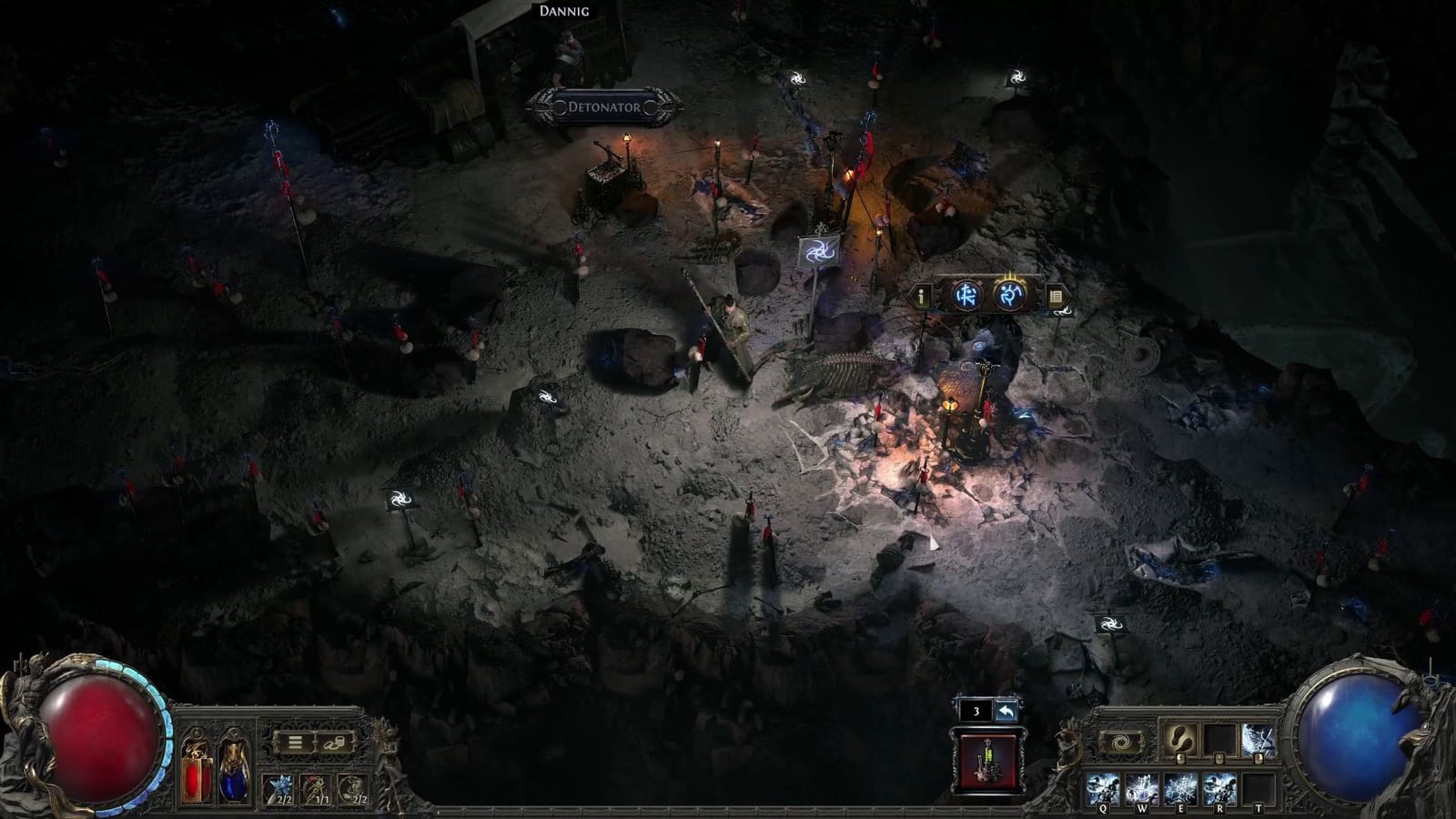
Every area holds an Ezomyte Remnant, an ancient stone slab partly inscribed with runes. You walk up, click it, and a window opens showing the rune slots and whatever runes are already locked in. From there you do not type in runes one by one. You pick the reward you want, and the game fills the matching rune combination for you automatically.
The catch is that the runes you complete buff the monsters that spawn around the Remnant. A Fire Rune adds extra fire damage to the pack. A Moon Rune makes enemies conjure Moon Beams. Longer recipes pull in more runes, which means tougher, more dangerous packs, but also rarer rewards and more waves to clear. After you kill the empowered monsters, the reward is yours, and the pack drops Verisium on the way down.
In the campaign you usually get one Remnant per zone with a single pack tied to it. That makes it a clean, bite-sized decision: take the safe short recipe for a guaranteed upgrade, or gamble on a longer one when your build can handle the heat.
The Rune System and Recipes
Runes of Aldur adds over 100 new socketable runes to the game, and you do not have access to all of them right away. You unlock more runes and more recipe combinations as you progress and collect Runestones, so the menu of rewards a Remnant can offer grows the deeper you get.
Recipes work by combining runes into a result. Mixing a Tempest and a Lightning Rune, for example, produces an Orb of Augmentation. Each rune slot you complete is both a crafting input and a monster modifier, so reading a Remnant is really two questions at once: what do I want to make, and can I survive the pack that making it summons?
⚡ Quick tip: Short recipes are not a waste. Early in a zone, a two-rune reward you can clear instantly keeps your Verisium income steady. Save the long, scary recipes for when your damage and defenses can actually back them up.
Runeforging, Verisium, and Runic Ward
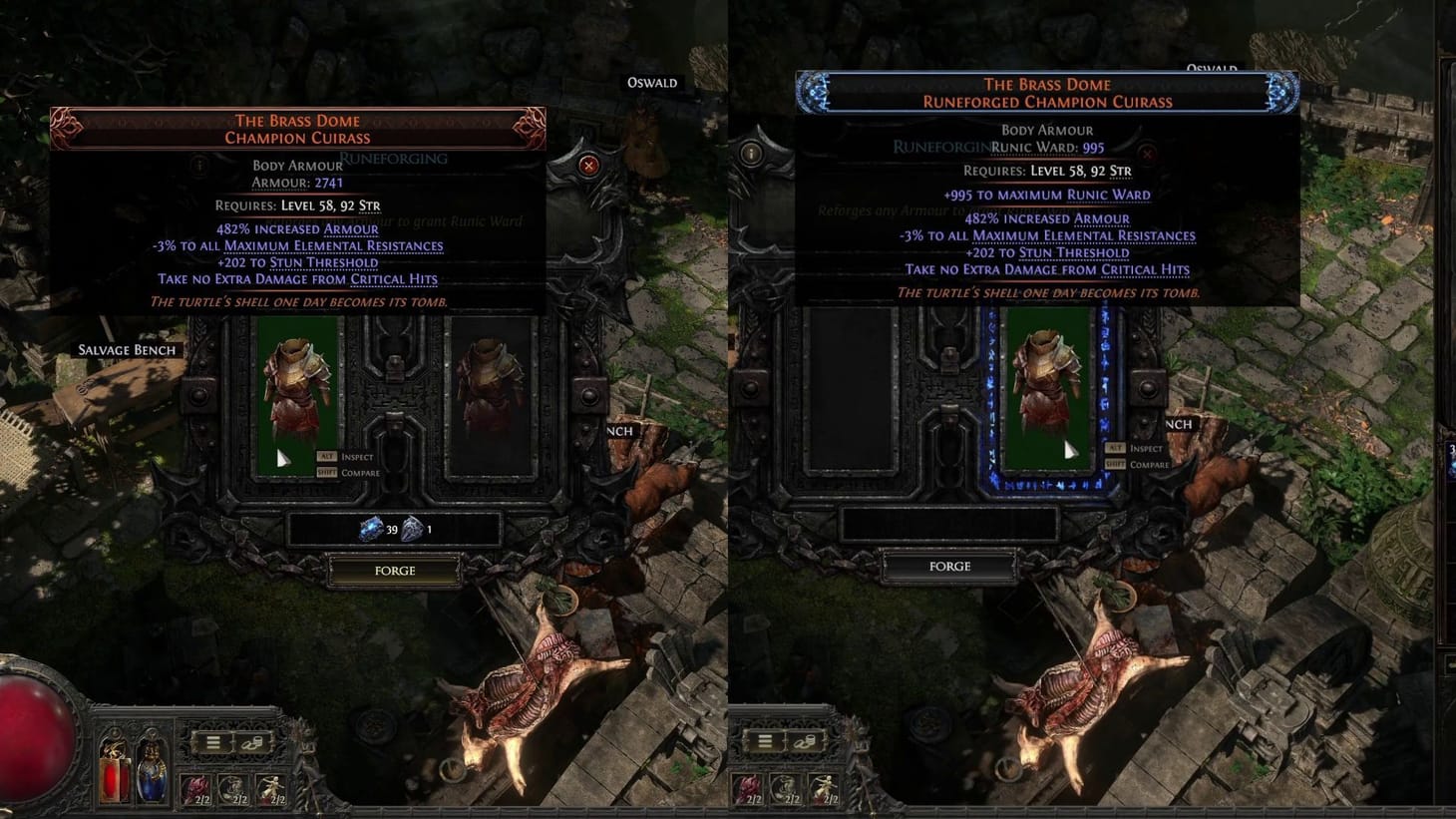
Verisium is the mineral the Remnant monsters drop, and it is the heart of the league’s crafting. You spend it at the Forge through Runeforging, which unlocks for armor after Act 1 and for weapons from Act 3 onward. Runeforging does three useful things.
- Armor: reforge a piece to trade its base defenses for Runic Ward. In the screenshot above, a body armour gets reforged into a version granting +995 to maximum Runic Ward.
- Weapons: upgrade a low-level Unique weapon so it scales into endgame-viable damage, which keeps an early favorite relevant far longer than usual.
- Uniques: reforge Kalguuran and Ezomyte Unique items to change their modifiers when the base item is good but the rolls are not.
Runic Ward is the defensive twist that makes 0.5 feel different to play. It is a second pool that sits behind your Life. Damage chews through Life first, and once Life is gone, Ward keeps absorbing hits, then regenerates slowly over time. It is the inverse of Energy Shield, which sits in front of Life. Build around it and you get a cushion that buys you the second or two you need to disengage and recover.
One thing to plan for: Runeforged armor gives up its normal armor, evasion, or energy shield in exchange for that Ward. So this is a real build decision, not free value. If your defenses already lean on Energy Shield, layering Ward on top changes how you survive, and it pairs naturally with the new skills below.
Kalguuran Skills and New Currency
The league adds more than 40 Kalguuran skill gems, and they run on Runic Ward instead of Mana. They have no attribute requirements and work with any damage type, so they slot into builds that normally could not touch them. Most of them reshape a skill you already use rather than replacing it. A few examples that have shown up in the patch:
- Repulsion: knocks back the enemies around your target whenever you damage it.
- Triskelion Cascade: triggers your next cast three times.
- Frostlame Nova: transforms Ignite into Frostfire on burning enemies.
Alongside the gems, Runesmithing introduces a few new crafting currencies worth knowing. Alloys replace a random modifier on an item with a guaranteed one. Augment Runes socket into gear for extra modifiers, and some of them change how a skill functions outright. Aldur’s Legacy lets you destroy a Unique Kalguuran or Ezomyte item to create a Legacy rune that keeps the item’s power for use on the same type of gear, which is a clean way to recycle a Unique you have outgrown. If you want a build that leans into the league’s summon-heavy options, our best minion builds for 0.5 pairs well with the extra defensive headroom Ward provides.
Runes of Aldur in the Endgame
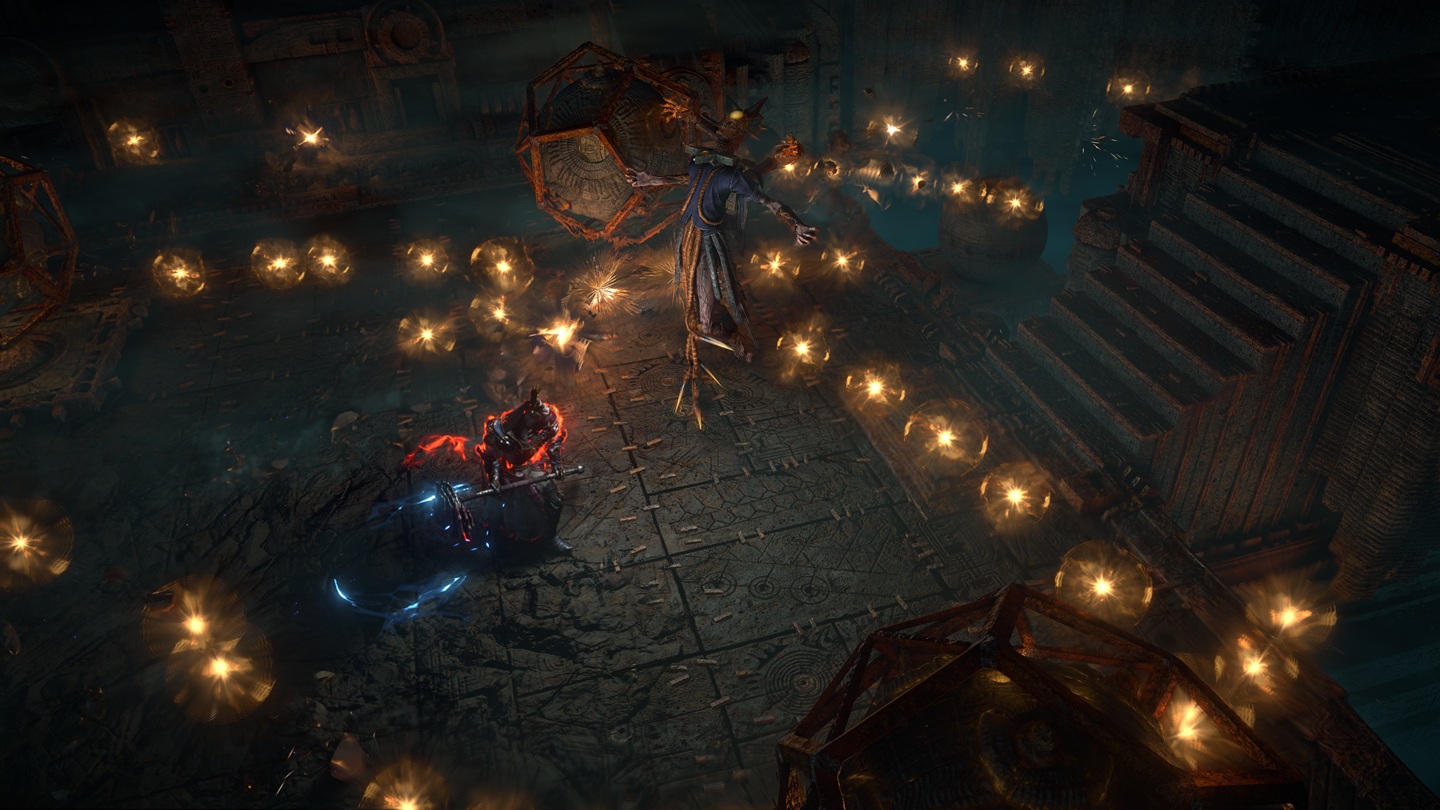
In maps, Runes of Aldur folds into Expedition. Remnants sit inside Expedition areas and only activate after you detonate the bombs, and the rune modifiers then apply to the monsters caught in the explosion chain. So your endgame Verisium farm and your Expedition runs become the same activity.
Patch 0.5.4, released June 24, 2026, deepened that loop. It added an Expedition Atlas Passive Tree built around Runes of Aldur, where you spend points to tune the difficulty and rewards of your Verisium Remnant and Expedition encounters. You earn those passive points by beating bosses in the Grand Expedition questline. The same patch introduced Liquid Verisium, a currency that lets you start a Runic Remnant encounter on demand instead of waiting for one to appear.
The league has its own boss roster too, capped by pinnacle fights like the Vessel of Kulemak, the Bodach, and the Raven Trickster. These are where the best league-specific loot lives, including Unique items you can then reroll with Runeforging.
How to Farm Runes of Aldur Efficiently
The mechanic rewards a few simple habits once you understand the loop. Here is the order of operations that keeps you moving instead of stalling.
- Hit every Remnant. One spawns per campaign zone, and skipping them means leaving free Verisium and runes on the table.
- Match the recipe to your build. Take the longer, scarier recipes only when your clear speed and survivability can handle the empowered pack. Otherwise grab the quick reward and move on.
- Runeforge a weapon early. Turning a cheap low-level Unique into an endgame-scaling weapon is the single biggest power spike the league hands you in the acts.
- Plan defenses around Ward. Decide early whether you are committing to Runic Ward, because Runeforged armor gives up its base defenses for it. Pair it with Kalguuran skills that spend Ward so the resource does double duty.
- Spec the Atlas tree in maps. Once you are farming Expedition, put points into the Runes of Aldur Atlas passives and use Liquid Verisium to chain encounters back to back.
If you are weighing whether to jump in now or wait for 1.0, our look at the road to Path of Exile 2’s 1.0 launch puts this league in context. Since 0.5 is the final stop before release, the gear and currency you bank now carry real meaning.
Gear for Long Path of Exile 2 Sessions
Path of Exile 2 is a click-heavy ARPG, and a league built on clearing dense empowered packs only ups the input count. A responsive mouse, a keyboard you can reach every flask and skill on, and a desk pad big enough for fast sweeps all earn their keep on hour three. As of June 2026, this trio covers the basics without overspending.

Razer Orochi V2
Lightweight wireless mouse with 18K DPI and long battery life, easy on the hand during marathon mapping.

Keychron C2 Pro
Full-size hot-swappable mechanical board with the number row you want for flasks and skill swaps.

Corsair MM350 PRO XL
Spill-proof extended cloth pad with room for big low-sensitivity sweeps across a full screen of mobs.
Between mapping sessions, Berry Finds tracks real-time Amazon deals on thousands of everyday products across home, kitchen, beauty, and more, so you never overpay on the stuff you buy regularly.
Frequently Asked Questions
What is the current Path of Exile 2 league in June 2026?
The current league is Runes of Aldur, which launched with the 0.5 Return of the Ancients update on May 29, 2026. It is the largest and final Early Access patch before the 1.0 launch, so there is no further numbered league planned before release.
How does the Runes of Aldur mechanic work?
You click an Ezomyte Remnant in a zone, choose the reward you want, and the game completes the matching rune recipe. The runes empower the monsters that spawn around the Remnant, and once you defeat them you claim the reward. The monsters also drop Verisium for crafting.
What is Verisium used for?
Verisium is the league currency dropped by Remnant monsters. You spend it at the Forge through Runeforging to add Runic Ward to armor, upgrade low-level Unique weapons to endgame damage, and reforge Kalguuran or Ezomyte Unique items to change their modifiers.
What is Runic Ward in Path of Exile 2?
Runic Ward is a new defensive resource that acts as a second pool behind your Life. Damage drains Life first, and after Life is gone, Ward keeps absorbing hits before regenerating over time. It is the opposite of Energy Shield, which sits in front of Life, and it also fuels the new Kalguuran skills.
Are the Kalguuran skills worth using?
They can be, since they cost Runic Ward instead of Mana, have no attribute requirements, and work with any damage type. Skills like Repulsion, Triskelion Cascade, and Frostlame Nova mostly modify a skill you already run, so they fit builds that are already committing to Ward as a defense.
Will my Runes of Aldur progress carry into 1.0?
Runes of Aldur is the final Early Access league, and 0.5 runs until the 1.0 launch. Grinding Gear Games has not detailed every transition rule for the full release, so treat the league’s items and currency as relevant for now and check the official patch notes as 1.0 approaches.
Summary
Runes of Aldur turns every zone into a small crafting gamble: pick a reward, fight the pack your runes just buffed, and bank the Verisium to forge your own upgrades. The two systems that change how the game feels are Runeforging, which lets you trade armor defenses for a Ward pool or push an old Unique weapon back into relevance, and the Kalguuran skills that spend that Ward. In the endgame it merges with Expedition, and the 0.5.4 Atlas tree plus Liquid Verisium make farming it faster.
It is also the last numbered league before Path of Exile 2 hits 1.0, which is a big part of why it has the game sitting near the top of Steam’s most-played list right now. Learn the Remnant loop, commit to a defensive plan around Runic Ward, and the rest of the league opens up fast.