Every Phasmophobia match comes down to one question: which of the ghost types is haunting the building? You gather three pieces of evidence, cross names off in your journal, and confirm the ghost before it hunts you down. This guide is the full evidence chart for all 27 ghosts, plus the behavior tells that let you name a ghost even when the evidence is missing or a Mimic is lying to you. It is current as of July 2026 and includes the three ghosts added in the Winter’s Jest update: the Obambo, the Gallu, and the Dayan.
Read it once to understand how identification actually works, then keep the evidence table open on a second screen while you play. That is how you go from guessing to confirming.
Key Takeaways
- 27 ghost types, 7 evidence types: each ghost gives a unique combination of three evidence types, and matching all three confirms the ghost.
- The 7 evidence types: EMF Level 5, Spirit Box, Ultraviolet fingerprints, Ghost Writing, Freezing Temperatures, D.O.T.S Projector, and Ghost Orbs.
- Behavior beats evidence: hunt speed, sanity thresholds, and unique tells identify a ghost when evidence is short, and they catch the two liars, the Mimic and the Obake.
- Three new ghosts (Winter’s Jest, December 2025): the Obambo, Gallu, and Dayan each swing between weak and strong states, so learn their triggers to survive.
- Your voice is a tool: the Spirit Box and Parabolic Microphone are voice-driven, so a clear mic like the Shure MV6 genuinely changes how reliably you pull evidence.
- How Ghost Identification Works
- The 7 Evidence Types Explained
- Full Evidence Chart: All 27 Ghost Types
- How to Identify a Ghost Step by Step
- Sanity, Hunts, and the Non-Evidence Tells
- The Three New Ghosts: Obambo, Gallu, and Dayan
- Common Identification Mistakes
- Frequently Asked Questions
- Gear for Ghost Hunting
- Summary
How Ghost Identification Works
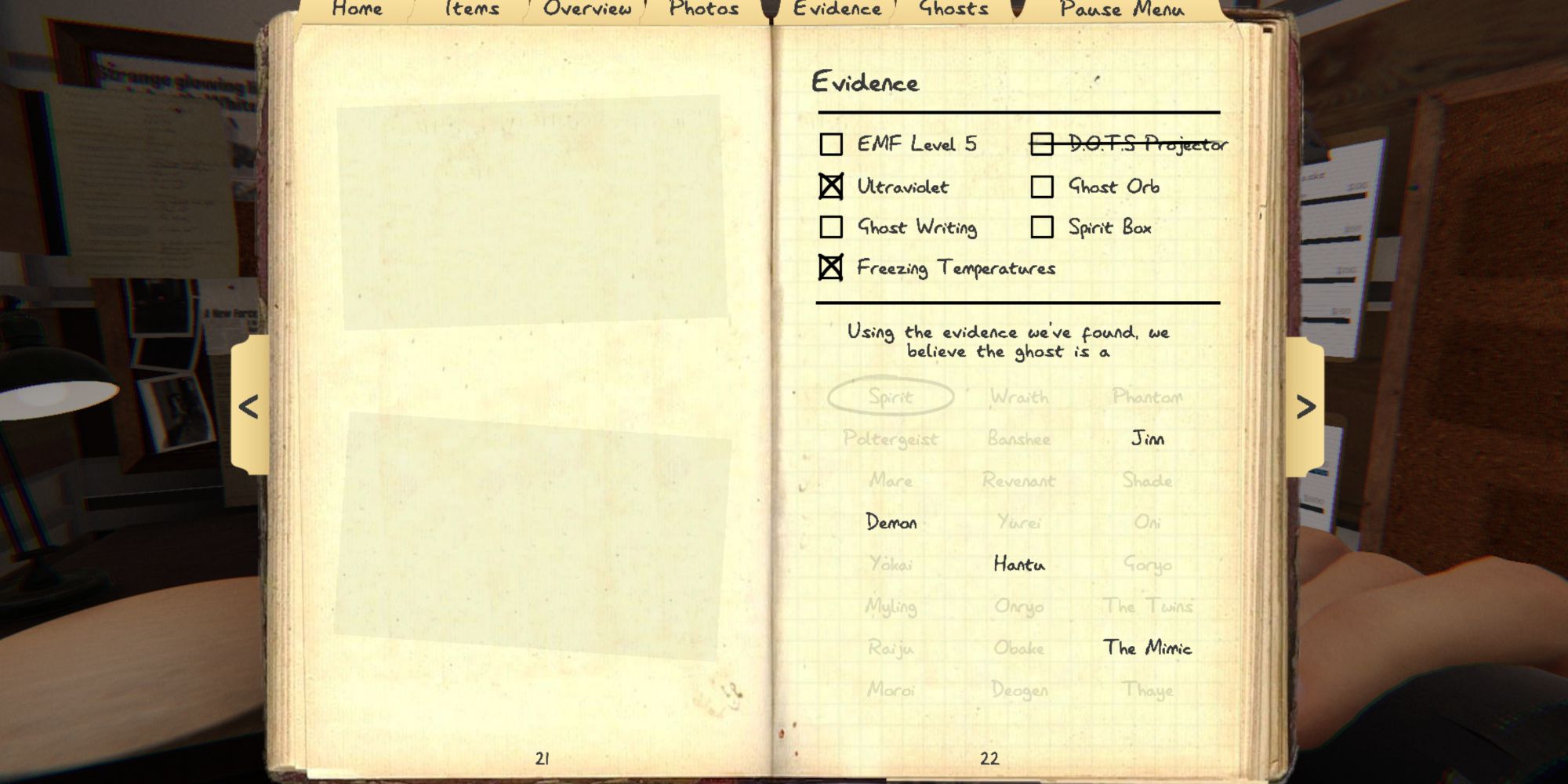
Ghost identification in Phasmophobia is a process of elimination built on evidence. There are 27 ghost types in the game, and each one leaves a fixed set of three evidence types out of a possible seven. Your job is to find those three, mark them in the journal, and let the game narrow the list down to a single name.
The journal does the math for you. Tick two evidence types and it grays out every ghost that cannot produce both. Tick the third and usually one name is left. On higher difficulties you get fewer evidence types to work with, which is where the behavior tells in this guide become the difference between a correct guess and a wrong one.
Two ghosts break the clean three-evidence rule on purpose. The Obake can skip its Ultraviolet evidence, and the Mimic fakes a fourth evidence type, Ghost Orbs, on top of the three it copies. Both are covered in the chart and the mistakes section below.
The 7 Evidence Types Explained
Before the chart makes sense, you need to know what each evidence type looks like in the field and which tool finds it. These seven are the entire language of ghost hunting.
| Evidence | Tool | What You See |
|---|---|---|
| EMF Level 5 | EMF Reader | The reader spikes all the way to 5 (red) when the ghost interacts with something. |
| Spirit Box | Spirit Box | The ghost answers out loud when you ask questions in a dark room close to it. |
| Ultraviolet | UV Flashlight / Glowstick | Handprints, fingerprints, or footprints glow on doors, switches, and windows. |
| Ghost Writing | Ghost Writing Book | Text scrawls into a book you leave near the ghost’s room. |
| Freezing Temperatures | Thermometer | The room drops below 0°C and your character’s breath becomes visible. |
| D.O.T.S Projector | D.O.T.S Projector | A ghost silhouette walks through the projector’s laser grid, seen on camera or through the video screen. |
| Ghost Orbs | Video Camera (night vision) | Floating orbs drift through the room, visible only on a camera feed, never with your own eyes. |
A quick note on two of them. Ghost Orbs and D.O.T.S both require a video camera to spot, so set cameras early. And Freezing Temperatures needs the room genuinely below freezing, not just cold, so give the thermometer time to settle before you rule it out.
Full Evidence Chart: All 27 Ghost Types
This is the reference you keep open while playing. Every ghost, its three evidence types, and the one behavior that separates it from ghosts with the same evidence. As of July 2026 this covers the complete 27-ghost roster.
| Ghost | Evidence | Key Tell |
|---|---|---|
| Spirit | EMF 5, Spirit Box, Ghost Writing | Smudging its room blocks hunts for 180 seconds, double the normal time. |
| Wraith | EMF 5, Spirit Box, D.O.T.S | Never steps in salt and leaves no salt footprints. |
| Phantom | Spirit Box, Ultraviolet, D.O.T.S | Taking its photo makes it vanish for a moment; looking at it drains less sanity than other ghosts. |
| Poltergeist | Spirit Box, Ultraviolet, Ghost Writing | Throws multiple objects at once with force. |
| Banshee | Ultraviolet, Ghost Orbs, D.O.T.S | Targets one player at a time; its scream shows on the Parabolic Microphone. |
| Jinn | EMF 5, Ultraviolet, Freezing | Speeds up at a distance if it has power; cannot turn the breaker off. |
| Mare | Spirit Box, Ghost Orbs, Ghost Writing | Turns lights off and hunts earlier in the dark. |
| Revenant | Ghost Orbs, Ghost Writing, Freezing | Very fast while it can see you, crawls slowly when it cannot. |
| Shade | EMF 5, Ghost Writing, Freezing | Shy; will not act or hunt while a player is in its room. |
| Demon | Ultraviolet, Ghost Writing, Freezing | Hunts early and often, and can hunt at any sanity level. |
| Yurei | Ghost Orbs, Freezing, D.O.T.S | Drains sanity hard; smudging its room traps it there for a short time. |
| Oni | EMF 5, Freezing, D.O.T.S | More active when players are near; does not do airball or mist events. |
| Yokai | Spirit Box, Ghost Orbs, D.O.T.S | Talking near it can trigger a hunt; during hunts it only hears voices close by. |
| Hantu | Ultraviolet, Ghost Orbs, Freezing | Moves faster in cold rooms and slower in warm ones; breath is visible while hunting. |
| Goryo | EMF 5, Ultraviolet, D.O.T.S | Only shows on a D.O.T.S camera when no one is in the room with it. |
| Myling | EMF 5, Ultraviolet, Ghost Writing | Quieter footsteps during hunts, but makes frequent paranormal sounds otherwise. |
| Onryo | Spirit Box, Ghost Orbs, Freezing | Can start a hunt whenever a flame near it is blown out; fears fire. |
| The Twins | EMF 5, Spirit Box, Freezing | Two interactions fire close together; one twin hunts slower, the other faster. |
| Raiju | EMF 5, Ghost Orbs, D.O.T.S | Faster near active electronics and disrupts equipment from farther away. |
| Obake | EMF 5, Ultraviolet, Ghost Orbs | Sometimes skips its UV evidence; can leave a six-fingered handprint, and prints fade fast. |
| The Mimic | Spirit Box, Ultraviolet, Freezing | Copies another ghost’s abilities and always shows Ghost Orbs as a fake fourth evidence. |
| Moroi | Spirit Box, Ghost Writing, Freezing | Curses you through the Spirit Box; the lower your sanity, the faster it moves. |
| Deogen | Spirit Box, Ghost Writing, D.O.T.S | Always senses where you are; sprints from far away but crawls when close. |
| Thaye | Ghost Orbs, Ghost Writing, D.O.T.S | Starts fast and aggressive, then weakens the longer the team stays in the building. |
| Obambo (new) | Ghost Writing, Ultraviolet, D.O.T.S | Flips between calm and aggressive states; hunts about 20% shorter while aggressive. |
| Gallu (new) | EMF 5, Ultraviolet, Spirit Box | Protective gear enrages it and weakens that gear, until it tires and the gear works again. |
| Dayan (new) | EMF 5, Ghost Orbs, Spirit Box | Grows stronger when people move nearby and weaker when they stand still. |
Two rows deserve extra caution. The Obake only produces its Ultraviolet evidence about 75% of the time, so a missing fingerprint does not rule it out. The Mimic will always show Ghost Orbs even though orbs are not one of its three real evidence types, which is the single most reliable way to catch it.
How to Identify a Ghost Step by Step
The fastest investigations follow the same order every time. Work the room methodically instead of chasing every noise.
- Find the ghost room. Drop the EMF Reader and Thermometer as you move; the ghost room is usually the coldest room with the most activity.
- Set up cameras and passive tools. Place a video camera for Ghost Orbs, a D.O.T.S Projector, a Ghost Writing Book, and a motion or sound sensor in the room.
- Gather your first two evidence types. Sweep with the UV light, ask the Spirit Box questions in the dark, and watch the EMF Reader for a level 5 spike.
- Check the camera feed from the truck. Ghost Orbs and the D.O.T.S silhouette only appear on the video screen, so review the feed rather than looking with your own eyes.
- Confirm the third evidence, then verify with behavior. Once the journal narrows to one name, watch for that ghost’s unique tell to be sure before you write your final answer.
On Nightmare and Insanity difficulty you get one or two fewer evidence types, so the final step is not optional. That is when hunt speed, sanity thresholds, and the tells in the chart carry the identification. Playing with friends speeds all of this up, and if you enjoy the co-op format, our roundup of the best prop hunt and hide-and-seek games has more picks for a full lobby.
Sanity, Hunts, and the Non-Evidence Tells
Most ghosts can only start a hunt once the team’s average sanity drops to 50%. A handful break that rule, and the sanity a hunt begins at tells you which ghost you are dealing with even before you have all three evidence types.
| Ghost | Hunts At | Why It Matters |
|---|---|---|
| Most ghosts | 50% average sanity | The baseline; a hunt near 50% tells you nothing special. |
| Demon | Any sanity | A hunt above 70% sanity strongly points to a Demon. |
| Mare | 60% dark / 40% lit | Early hunts in a dark room suggest a Mare; keeping lights on delays it. |
| Yokai | Up to 80% if you talk | Talking near a Yokai can trigger an early hunt; staying silent drops it to 50%. |
| Shade | Only below 35% | No hunts despite low sanity points to a shy Shade. |
Hunt speed is the other non-evidence tell. A normal ghost moves at a steady pace, but several ghosts break from it in ways you can read mid-hunt:
- Revenant: sprints when it has line of sight, slows to a crawl when it loses you.
- Deogen: rushes from across the map, then crawls once it reaches you, so it is easy to loop.
- Moroi: gets faster the lower the team’s sanity, so keep sanity high against it.
- Hantu: faster in cold rooms; turn the heating on to slow it down.
- Raiju: faster near active electronics, so drop your gear if it is chasing you.
- Thaye: fast early, then slows the longer you stay in the building.
The Three New Ghosts: Obambo, Gallu, and Dayan
The Winter’s Jest update in December 2025 added three ghosts drawn from global folklore. Each one swings between a weak and a strong state, so identifying the trigger is how you stay alive against them.
Obambo
Evidence: Ghost Writing, Ultraviolet, D.O.T.S. The Obambo flickers between calm and aggressive states on a fairly steady cycle, roughly two minutes apart, regardless of what you do to it. In its aggressive state it starts hunts sooner, but those hunts run about 20% shorter than normal. Time its state changes with a stopwatch, and if the phases stay even at around two minutes even after you cross salt, you are looking at an Obambo.
Gallu
Evidence: EMF Level 5, Ultraviolet, Spirit Box. The Gallu is a second demon-type ghost, and protective equipment provokes it. Using items like crucifixes or incense pushes it into an enraged state that weakens their effect, until the rage tires it out and the gear works normally again. Salt lines help confirm it: the Gallu deliberately disturbs salt as it enters an enraged state, which separates it from a Wraith that avoids salt entirely.
Dayan
Evidence: EMF Level 5, Ghost Orb, Spirit Box. The Dayan is hyper-aware of movement. It gains strength when people move near it and loses strength when everyone stands still. A useful tell is comparing EMF readings inside its favorite room versus outside; the Dayan tends to spike higher while a player is present. Against it, hold position during a hunt rather than sprinting circles, because constant movement is exactly what powers it up.
Common Identification Mistakes
Do This
- Give the thermometer time to settle before ruling out Freezing Temperatures.
- Check Ghost Orbs and D.O.T.S on the camera feed, never with your own eyes.
- Watch for Ghost Orbs on a three-evidence ghost to catch a Mimic.
- Confirm the journal’s answer with a behavior tell before writing it down.
- Keep sanity high against a suspected Moroi or Demon.
Avoid This
- Assuming a missing fingerprint rules out an Obake; it skips UV about 25% of the time.
- Ignoring the sanity level a hunt starts at; it is free identification.
- Talking near a Yokai unless you want an early hunt.
- Sprinting in loops against a Dayan, which only makes it stronger.
- Calling the ghost on two evidence types when a third is still gettable.
Frequently Asked Questions
How many ghosts are in Phasmophobia?
There are 27 ghost types as of July 2026. The most recent additions were the Obambo, Gallu, and Dayan, added in the Winter’s Jest update in December 2025.
What are the 7 evidence types in Phasmophobia?
The seven evidence types are EMF Level 5, Spirit Box, Ultraviolet fingerprints, Ghost Writing, Freezing Temperatures, D.O.T.S Projector, and Ghost Orbs. Each ghost gives a fixed combination of three of them.
How do you identify a ghost with only two evidence types?
Use behavior tells. Hunt speed, the sanity level a hunt starts at, and each ghost’s unique quirk narrow the list when evidence is short. On Nightmare and Insanity difficulty, where you get fewer evidence types, these behavior clues are how you confirm the ghost.
How do you catch a Mimic in Phasmophobia?
The Mimic copies another ghost’s three evidence types but always shows Ghost Orbs as a fake fourth. If a ghost that should only have three evidence types is also giving Ghost Orbs, it is a Mimic.
Why does my ghost have no fingerprints?
It may be an Obake, which skips its Ultraviolet evidence about 25% of the time. A missing fingerprint does not rule out an Obake, so lean on its other evidence and its fast-fading, sometimes six-fingered prints.
What sanity do ghosts hunt at in Phasmophobia?
Most ghosts hunt once average sanity drops to 50%. Exceptions include the Demon, which can hunt at any sanity, the Mare at 60% in the dark, the Yokai up to 80% if you talk near it, and the Shade, which only hunts below 35%.
Gear for Ghost Hunting
Phasmophobia is a game you play with your ears and your voice. The Spirit Box and Parabolic Microphone respond to what you say and pick up faint ghost sounds, so a clear mic and a headset that surfaces quiet footsteps do real work here. This trio covers both sides without overspending. As of July 2026, these are the prices from the deals database.

Shure MV6 USB Microphone
Crisp, close-up voice pickup so the Spirit Box actually registers your questions on the first try.

JBL Quantum 400
Positional audio that makes faint footsteps and whispers easy to place in a pitch-black room.
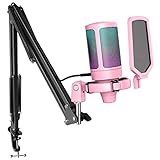
FIFINE USB Microphone Kit
The cheapest reliable way to get clean voice recognition for the Spirit Box and team comms.
Between ghost hunts, Berry Finds tracks real-time Amazon deals on thousands of everyday products across home, kitchen, beauty, and more so you never overpay on the stuff you buy regularly.
Summary
Identifying Phasmophobia’s ghost types comes down to two layers: match three of the seven evidence types in your journal, then confirm with the behavior tell that separates ghosts sharing the same evidence. Keep the 27-ghost chart open while you play, watch the sanity level each hunt starts at, and remember the two liars, the Obake that hides its fingerprints and the Mimic that fakes Ghost Orbs. For another co-op game where your voice is the main mechanic, see our Big Walk walkie-talkie guide.
The Winter’s Jest trio, the Obambo, Gallu, and Dayan, add state-swapping ghosts that reward learning their triggers over rushing the call. Get a clear mic like the Shure MV6 so the Spirit Box hears you, grab a friend or two, and you will name the ghost before it names you. For more co-op nights, our list of the best couch co-op games is worth a look, and horror fans should check our Resident Evil Requiem beginner guide. If your squad wants a different flavor of monster identification, our Shift At Midnight doppelganger tells guide breaks down a game Steam now bundles with Phasmophobia.