This guide has been updated with some corrections since it was first published.
Monster Hunter Stories 3 has over 80 rideable monsties, and most of them will carry you through the early hours just fine. The problems start in Act 2, when Feral and Invasive monsters punish you for running a team held together by wishful thinking. Some monsties have base stats and default skills that make them objectively stronger than the rest, and no amount of gene transfer can close that gap completely.
Every monstie below was evaluated on stat spread, default skills, gene flexibility, and availability window. If you’re looking for a beginner guide covering combat basics and the Rite of Channeling, start there. This guide assumes you know how Power, Speed, and Technical work and want to know which monsties are worth your time.
Key Takeaways
- S-tier dominates: Dreadqueen Rathian, Boltreaver Astalos, and Purple Gypceros form the strongest trio available in Azuria and carry through endgame
- Status effects win fights: the best monsties inflict stun, poison, burn, sleep, or paralysis rather than just dealing raw damage
- Gene transfer matters less than base stats: the Rite of Channeling can add skills to any monstie, but it cannot change their stat spread or default Kinship Skill
- Build for coverage: carry one Power, one Speed, and one Technical monstie at minimum to win Head-to-Heads consistently
How We Ranked
Every monstie was evaluated on five factors:
| Factor | Why it matters |
|---|---|
| Base stats | HP, Attack, Defense, and Speed are locked per species. Gene transfer cannot change them. |
| Default skills | Kinship Skills and innate abilities define a monstie’s identity. You can add skills via channeling, but defaults are free. |
| Status infliction | Stun, sleep, poison, burn, paralysis, and bleed all generate extra value beyond raw damage. |
| Gene flexibility | Some monsties have better gene grids (more open slots, better bingo potential) for customization. |
| Availability | Earlier access means more time building toward endgame. A late-game monster needs to be significantly better to justify the wait. |
S-Tier Monsties
These five monsties are the best in Monster Hunter Stories 3 by a comfortable margin. Any two of them paired together will carry you through the main story and into post-game content.
Dreadqueen Rathian
Speed type, Fire element. The single strongest monstie in the game right now. Dreadqueen has absurdly high base HP, massive Fire Resistance, and a starting Attack stat that makes most other monsties look underpowered. Her main draw is Toxic Sweep (AoE poison) and Flame Tempest (AoE burn), two separate skills that together let her stack both damage-over-time effects across the entire field.
Getting her takes some work. You need to push a Rathian or Pink Rathian’s ecosystem to S-rank with three Poison monsties present in the habitat. The effort is worth it. Once you have her, she trivializes most encounters in the game because enemies are constantly ticking down from poison and burn while she keeps swinging.
Boltreaver Astalos
Technical type, Thunder element. The burst damage specialist. Boltreaver has a high critical hit rate and a Kinship Skill that buffs its own Attack, creating a feedback loop where it hits harder with every turn. Astalos Saber is a strong Thunder skill that also grants Attack Up, so it functions as both offense and self-buff in a single action.
To get Boltreaver, you need a base Astalos egg from Mirror Lake (northwest area) and then mutate it by placing it in a Lightning-element habitat with three Thunder monsties. Like Dreadqueen, the mutation process takes planning, but the payoff is a monstie that can one-round weaker enemies and chunk bosses.
Purple Gypceros
Power type, Non-elemental. The crowd control king. Purple Gypceros comes with Tail Stun, which completely stops an enemy monster for a full turn. It also learns Flash, which inflicts Darkness (causing missed attacks) and Poison. Stacking stun, blind, and poison on top of each other means enemies spend most of the fight either doing nothing or slowly dying.
The best part is availability. Purple Gypceros is accessible early through egg dens in Broadleaf Basin, Azuria, so you can build your team around it from almost the start. Pair it with Dreadqueen Rathian and Boltreaver Astalos and you have a team that locks enemies down while dealing massive damage.
Espinas
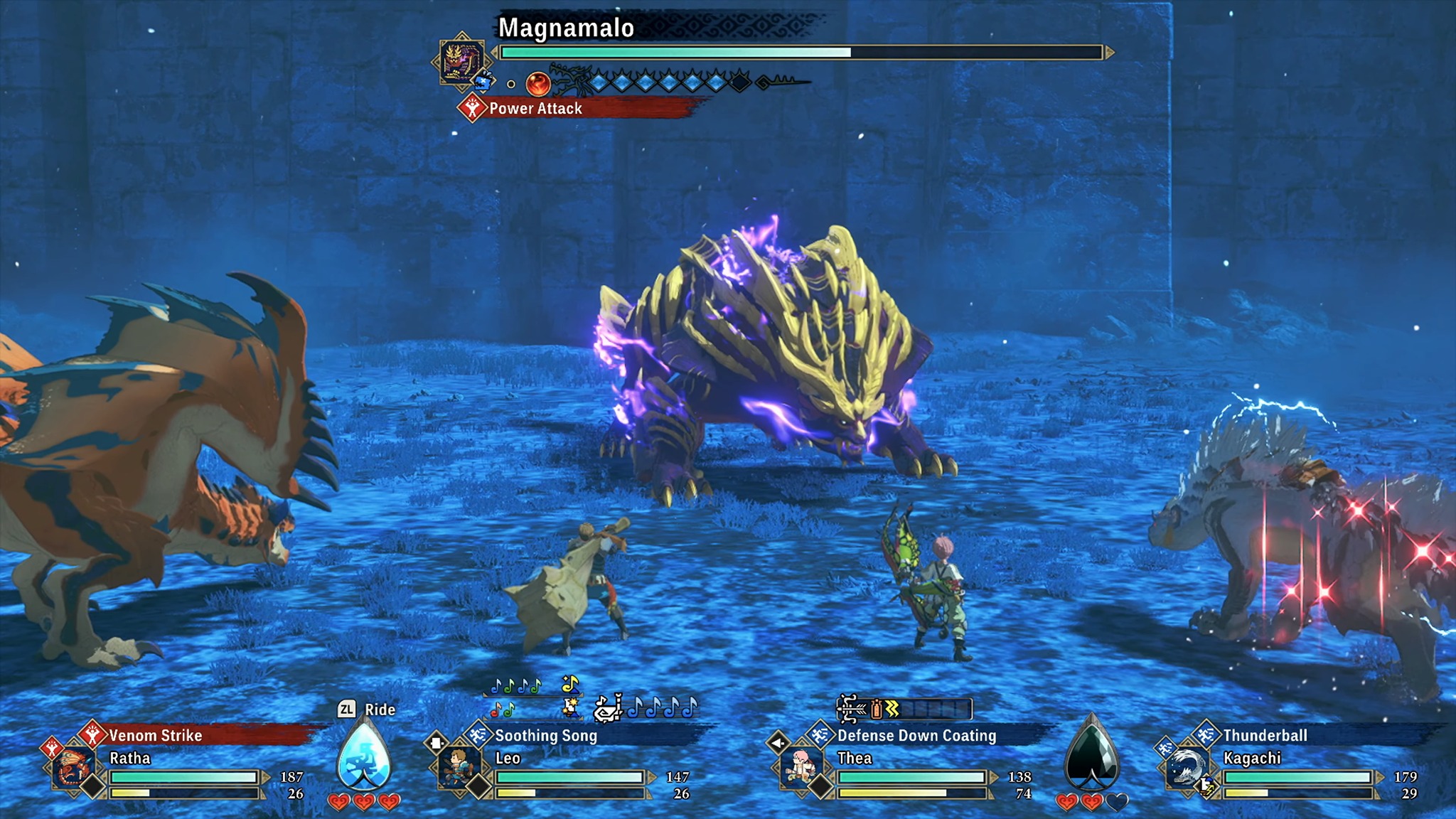
Power type, Fire element. The status effect destroyer. Espinas has one trick that no other monstie can match: its signature skill Venom Flame inflicts both Paralysis and Noxious Poison on a single target simultaneously. Paralysis locks the enemy down for a full turn while Noxious Poison ticks heavy damage over time. Stacking both at once means the target is either doing nothing or dying.
Espinas is obtainable by defeating it in Broadleaf Basin or finding its eggs in Tarkuan, and pairs naturally with Dreadqueen Rathian since both are Fire-element Power attackers. Where Dreadqueen spreads poison and burn across the field with AoE, Espinas concentrates its status effects on a single target for faster kills on bosses and invasive monsters. If you need one monstie to shut down a dangerous target, Espinas is the pick.
Velkhana
Technical type, Ice element. The stat debuffer. Velkhana has maxed-out HP, very high Attack, and respectable Speed and Defense across the board. What sets it apart from other stat-heavy monsties is its ability to inflict Skill Seal, which completely shuts down an enemy’s special moves for multiple turns.
In PvP, Skill Seal is devastating because it removes an opponent’s strongest options. In PvE, Velkhana’s combination of high survivability and consistent Ice damage makes it reliable against any encounter that doesn’t resist Ice. You unlock it after defeating Velkhana in the Serathis region.
A-Tier Monsties
A-tier monsties are strong enough to build a team around and will serve you well through the entire main story. They fall short of S-tier because of slightly worse stat spreads, narrower utility, or later availability.
Seregios
Technical type, Non-elemental. Shifts to Speed type when enraged. Very high Attack and Speed with an incredibly high Crit Rate. Seregios has unique skills that increase the chance of causing both Bleed and landing critical hits. The Normal element means almost nothing resists it, which makes Seregios a safe pick against any encounter where you’re unsure of the elemental matchup.
Silverwind Nargacuga
Speed type, Non-elemental. The highest Speed stat in the game, and it is not close. Every Nargacuga variant is fast, but Silverwind operates on a different level entirely. That Speed advantage means it strikes first in nearly every encounter, and first-strike wins in MH Stories 3 set the tempo for the whole fight by securing the opening Head-to-Head.
The tradeoff is some of the lowest Defense in the game, so Silverwind plays as a true glass cannon. Pair it with crowd control from Purple Gypceros or Nerscylla to keep enemies locked down while it sweeps. You unlock Silverwind Nargacuga by saving Nargacuga in Canalta Timberland and raising its Ecosystem Rank through habitat restoration until the mutation triggers.
Nerscylla
Technical type, Non-elemental. The sleep specialist. Nerscylla puts enemies to sleep and then follows up with Sleep Chaser, a skill that deals heavily amplified critical damage to sleeping targets. Sleep also gives you a free turn to heal your party or set up buffs. Available early, and it has Wall Climb for accessing hidden dens in the overworld. One of the strongest early-game picks that stays relevant through Act 3.
Namielle
Technical type, Water element. Namielle has one of the best stat spreads in the game: maxed HP, very high Defense, and strong Attack and Speed. It won’t win fights as fast as the burst damage dealers, but it almost never dies. If you want a monstie that can tank hits and keep fighting through long encounters, Namielle is the pick. Available after defeating it in the main story.
Stygian Zinogre
Technical type, Dragon element. Some of the highest Attack in the game with access to unique Dragon skills. The downside is moderate Defense and mixed resistances, so Stygian Zinogre plays more aggressively than defensively. If you can keep it alive through crowd control from teammates like Purple Gypceros, it puts out numbers that rival the top Power attackers like Espinas and Deviljho. Mid-to-late game availability.
B-Tier Monsties
B-tier monsties are reliable through the main story but get outclassed once you start unlocking mutations and post-game content. Many of them serve as stepping stones to their stronger evolved forms.
| Monstie | Type | Element | Role |
|---|---|---|---|
| Tobi-Kadachi | Speed | Thunder | Paralysis and self-buffing Thunder damage. Strong stamina recovery keeps it active longer than most. |
| Anjanath | Power | Fire | High raw Fire damage via Burning Fang. Solid early-game DPS with some defensive utility. |
| Pink Rathian | Speed | Fire | Flare Cluster (AoE) and Venom Sweep (group poison). Gateway to Dreadqueen Rathian. |
| Royal Ludroth | Power | Water | Debuffs enemy offense and defense. Enables swimming for map exploration. Available in Chapter 1. |
| Lagiacrus | Power | Thunder | High crit chance and Paralysis. Alternative to Tobi-Kadachi with slightly worse stamina economy. |
| Mizutsune | Technical | Water | Bubbly Dance grants Attack Up, Dodge Up, and Regenerate. All-rounder with strong Defense. |
B-tier monsties aren’t bad. Royal Ludroth in particular is one of the first monsties you’ll find, and its debuff kit punches above its weight class in early boss fights. But once you unlock the S-tier mutation options, these monsties shift from main roster picks to gene donors for the Rite of Channeling.
Best Early Game Team
You start with Ratha, Tobi-Kadachi, and Yian Kut-Ku. That’s a fine starter lineup, but you can upgrade it fast. Here’s the team to build as soon as possible in Azuria:
Purple Gypceros replaces Yian Kut-Ku immediately. Stun, blind, and poison in one monstie. It handles crowd control so your other two can focus on damage. Get it through early habitat restoration.
Nerscylla slots in as your Technical attacker. Sleep control is invaluable against Feral and Invasive monsties, and Wall Climb opens up hidden dens for better egg farming. Available early without any mutation requirements.
Ratha stays. Your starting Rathalos has poison attacks and versatile Fire skills that remain useful well into Act 2. Ratha is a one-of-a-kind monstie who scales better than most starters because of its gene grid flexibility. Swap it out later for Dreadqueen Rathian or Boltreaver Astalos once you unlock mutations.
This trio covers Power (Purple Gypceros), Technical (Nerscylla), and a flexible slot (Ratha) that handles whatever the other two can’t. Fill your remaining three party slots with a Water type (Royal Ludroth), a Thunder type (Tobi-Kadachi), and whichever monstie has the traversal skill you need for the current area.
Gene Transfer Tips
The Rite of Channeling in MH Stories 3 works differently than in previous games. You can drag and drop genes freely between your entire roster with no cost and no monstie sacrifice. That changes the strategy from “which monstie do I sacrifice?” to “which genes go where?”
The bingo system rewards matching three genes of the same type in a row (horizontal, vertical, or diagonal) on the 3×3 grid. Element bingos give a 5% damage boost to that element. Attack type bingos (Power/Speed/Technical) increase damage for those moves. Multiple bingos stack, so a grid with two or three active bingos deals noticeably more damage than one with none.
Practical approach: pick your S-tier monstie, stack genes that match its primary element or attack type in rows, and fill gaps with utility genes (status infliction, defensive buffs). For example, a Dreadqueen Rathian with a full Fire element row and a full Power row gets two bingo bonuses on top of its already strong base stats.
Excursions let you send monsties on training runs that grant regional stat bonuses and Environment Skills ranked B through S. Pair the right Environment Skills with aligned genes to unlock Awakened forms of those skills for even stronger effects. Check our MH Stories 3 beginner guide for a full breakdown of the Rite of Channeling basics.
For full 3×3 gene grid layouts optimized for each S-tier monstie above, see our Monster Hunter Stories 3 gene guide with bingo stacking strategies and endgame builds.
Recommended Gear for Long Sessions
MH Stories 3 runs 30-50 hours for the main story, and endgame egg farming adds plenty more on top of that. A good controller and comfortable audio setup make those longer sessions a lot easier to get through.
Monster Hunter Stories 3
Switch 2, PS5, Steam

8BitDo Ultimate 2C
Budget wireless controller for Switch 2 and PC
SteelSeries Arctis GameBuds
Cross-platform wireless earbuds with low latency
Frequently Asked Questions
Can gene transfer make any monstie S-tier?
No. The Rite of Channeling adds and swaps skills, but it cannot change a monstie’s base stats or default Kinship Skill. An S-tier monstie with good genes will always outperform a B-tier monstie with the same genes because the stat spread is locked per species.
What is the best team in Monster Hunter Stories 3?
Dreadqueen Rathian, Boltreaver Astalos, and Purple Gypceros. This trio covers AoE damage with poison and burn (Dreadqueen), single-target burst with self-buffing (Boltreaver), and full crowd control with stun, blind, and poison (Purple Gypceros). All three are obtainable in Azuria through habitat restoration.
When should I start mutating monsties?
As soon as you unlock habitat restoration in Azuria. Mutations require raising a monstie’s ecosystem to S-rank with specific elemental conditions, which takes time. Start the process early so your mutated monsties are ready by mid-game when difficulty spikes.
Does attack type matter more than element?
Both matter, but attack type determines Head-to-Head outcomes (Power beats Technical, Technical beats Speed, Speed beats Power), while element affects raw damage multipliers. Winning Head-to-Heads fills your Wyvernsoul gauge faster, so matching attack types against enemies is the higher priority in most fights.
Are early game monsties worth keeping for endgame?
Ratha (your starter Rathalos) and Nerscylla both remain viable through endgame content. Most other early monsties like Yian Kut-Ku and base Gypceros are better used as gene donors once you unlock their mutated versions. Royal Ludroth stays useful for its swimming traversal even if its combat falls off.
Prices on gaming peripherals and accessories change constantly. Berry Finds tracks real-time Amazon deals across thousands of products so you can grab gear at the lowest price.
Summary
The best monsties in Monster Hunter Stories 3 are the ones that combine high base stats with unique utility. Dreadqueen Rathian’s AoE poison and burn, Purple Gypceros’s stun lockdown, and Boltreaver Astalos’s crit-stacking burst damage form the strongest core team in the game. Fill around them with Nerscylla for sleep control, Seregios for safe Normal-element damage, and Velkhana for Skill Seal disruption. Many S-tier monsties have mutation variants that unlock through the habitat restoration system, including Thunderlord Zinogre and Dreadqueen Rathian.
Start building toward the S-tier mutations as soon as habitat restoration opens up in Azuria. The sooner you begin the ecosystem ranking process, the sooner you’ll have a team that stops getting punished by Feral encounters. And don’t sleep on gene transfer bingo bonuses. Two or three aligned rows on a Dreadqueen Rathian turns an already strong monstie into something that trivializes most of the game.