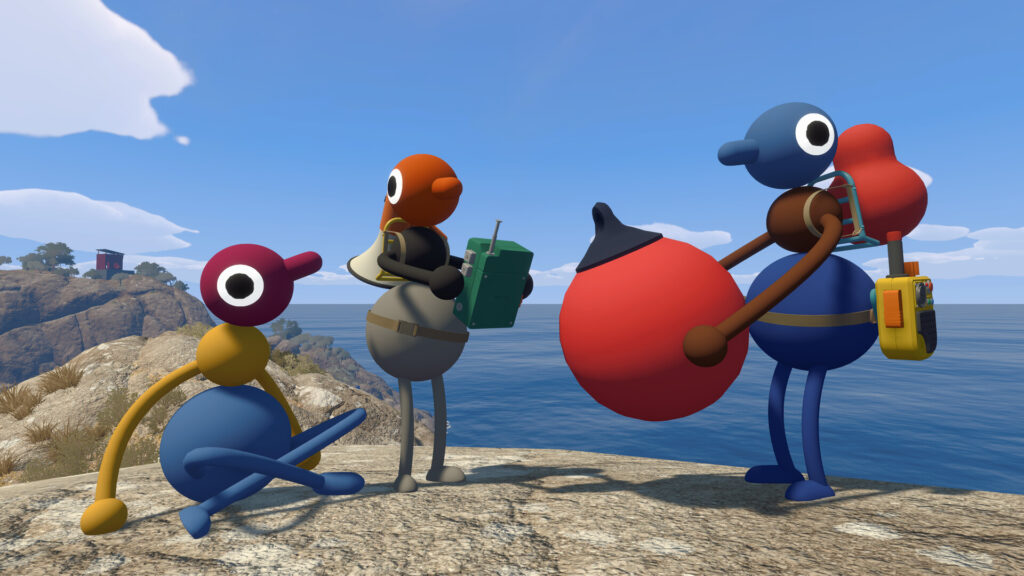
The Big Walk walkie-talkie extends your voice past the point where proximity chat gives out, and it is one of about a dozen items on the island built for getting a message across. House House made a co-op puzzle game where your voice fades to nothing after a few yards. This guide covers the falloff distance, how walkie-talkie pairs work, every signaling item, the puzzles designed to cut your comms, and the lobby setting you should change before your first session.
Key Takeaways
- Voice range is short: stray a few yards and you strain to hear a teammate, a few more and you hear nothing at all.
- Walkie-talkies share one channel: color is cosmetic, so any unit reaches any other, and a twelve-player lobby wants three spread across sub-groups.
- Text chat is a full alternative: House House gives it the same features as voice chat, so a player with no microphone can finish the whole game.
- Some puzzles cut your comms on purpose: soundproof rooms and one-way speakers are the challenge, which is why arm signals and light flashes matter.
- Set a lobby password first: Big Walk runs lobbies through Epic Online Services, and a community PSA documented that join codes can be queried publicly.
- How Proximity Voice Works
- Big Walk Walkie-Talkies: Pairs, Range, and Dead Zones
- Every Communication Tool on the Island
- Talking Without Talking: Gestures, Lights, and Codes
- The Puzzles Built to Cut You Off
- Why You Keep Losing the Walkie-Talkie
- The Quiet Voice Patch and What Still Breaks
- Set a Lobby Password Before You Start
- Why Discord Ruins It
- Gear for Hearing Every Word
- Frequently Asked Questions
- Summary
How Proximity Voice Works
Proximity voice in Big Walk attenuates with distance and geometry. Voices fade as you separate, echo down corridors, and muffle through walls. A voice arriving over a walkie-talkie crackles, so you can hear that it came through a handset rather than the air.
The falloff is steep. PC Gamer’s Tyler Wilde measured it against real life: if two of you could not hold a casual conversation standing 25 feet apart on a beach, you will not hear each other clearly in Big Walk either. Stray a few yards from a teammate and you are straining. A few more steps and there is nothing.
There is a text option, and House House describes it as carrying the same features as the in-game voice chat, with no part of the game locked behind speaking. A player with a broken mic can finish the whole thing on text.
Big Walk Walkie-Talkies: Pairs, Range, and Dead Zones
Walkie-talkies spawn in pairs and share one channel. Color does not separate them: a group on r/BigWalk compared two blue units against an orange one and found all three worked together. That means you do not need matching halves, and any walkie-talkie reaches any other.
Finding them is easier than combing the world on foot. Pair locations show on the big map as a small blue shape beside a small yellow one, and at the spawn itself the second unit sits directly across from the first. One player who set out to collect them all counted eight, or four sets of two.
Spread them across sub-groups rather than hoarding them. Two walkie-talkies cover a four-player group that moves in pairs, and a twelve-player lobby is better served with three so each cluster keeps a line back to the host. Hand them out before you scatter.
⚡ Quick tip: Walkie-talkies do not work everywhere. Players have reported them losing service inside certain puzzle interiors, so plan a visual backup before anyone walks into a sealed room.
Every Communication Tool on the Island
The island hands you far more than walkie-talkies. Each item covers a different way the group loses contact.
| Tool | What It Solves | Best Used When |
|---|---|---|
| Walkie-talkie | Two-way voice at any distance | A planned split between two known points |
| Megaphone | One-way voice further than normal | Calling a group that has drifted out of earshot |
| Binoculars | Seeing a teammate too far to hear | Reading arm signals across a valley |
| Laser pointer | Pointing at one exact thing at range | Naming a target you cannot describe |
| Flashlight | Light, and flashes as a code | Night, and any yes or no exchange through glass |
| Flare | A marker visible across the map | Regrouping after someone is lost |
| Whiteboards and signs | Written messages that persist | Leaving instructions at a fixed point |
| Cowbell | Sound without speech | Close range only, since players report ambient noise does not transmit over walkie-talkies |
The megaphone sits second to the walkie-talkie for long range. One player posted a range demonstration to r/BigWalk showing how far it carries before it cuts out, and a commenter in that thread ranked it behind walkie-talkies but ahead of everything else for reaching distance.
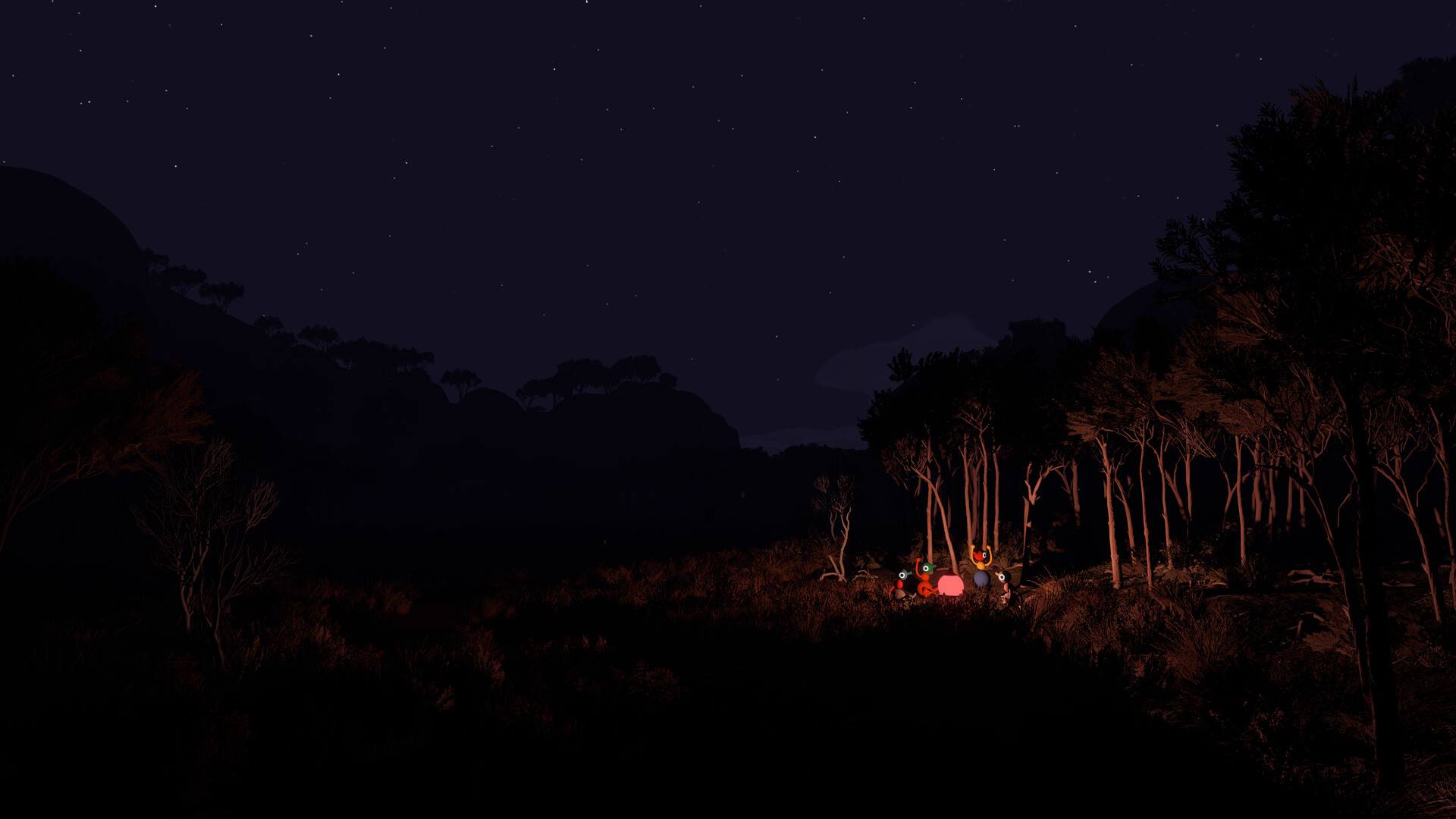
The day and night cycle moves quickly, and night in Big Walk is genuinely dark rather than videogame dark. Grab a flashlight or a carryable lantern early. Every visual signaling method above stops working when nobody can see your arms.
Talking Without Talking: Gestures, Lights, and Codes
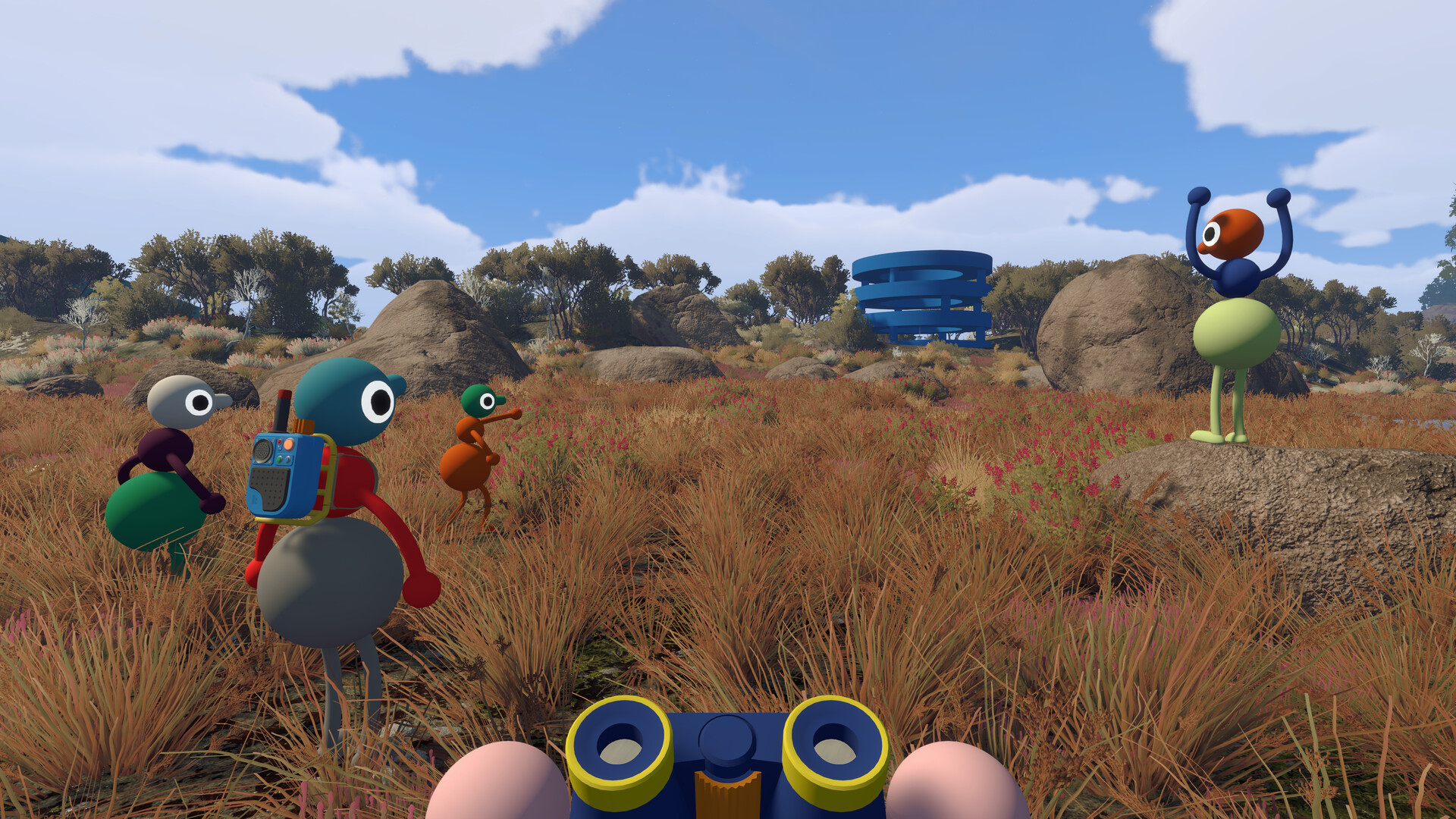
Your character’s arms are a communication device. You can point, wave, and raise both arms over your head, and a teammate with binoculars or a telescope can read those movements from across a valley. Several puzzles are built on exactly that exchange.
Agree on a code before you split up. Groups on r/BigWalk have settled on simple binary systems for situations where voice is blocked, and they are worth stealing:
- One flash for no, two for yes: a light source becomes a full answer channel, enough to work through a list of options one at a time.
- Read the list aloud, partner triggers on the right one: the player who can be heard names each option in order, and the silent player hits a switch when the correct one is called.
- Arm raise as a sequence: raising and lowering both arms in a pattern reads at binocular range where a point does not.
- Laser pointer for the exact object: when the item has no name, put the dot on it instead of describing it.
The laser pointer solves a specific problem: the puzzle rewards carry no in-game name, so every group invents its own word for them. Kotaku collected the ones reviewers and playtesters used, including gourds, eggs, peanuts, jelly babies, kongs, babies, the avocado, bowling pin, my son, and doodad. Agree on your group’s word early, because you will be shouting it across a canyon.
The Puzzles Built to Cut You Off
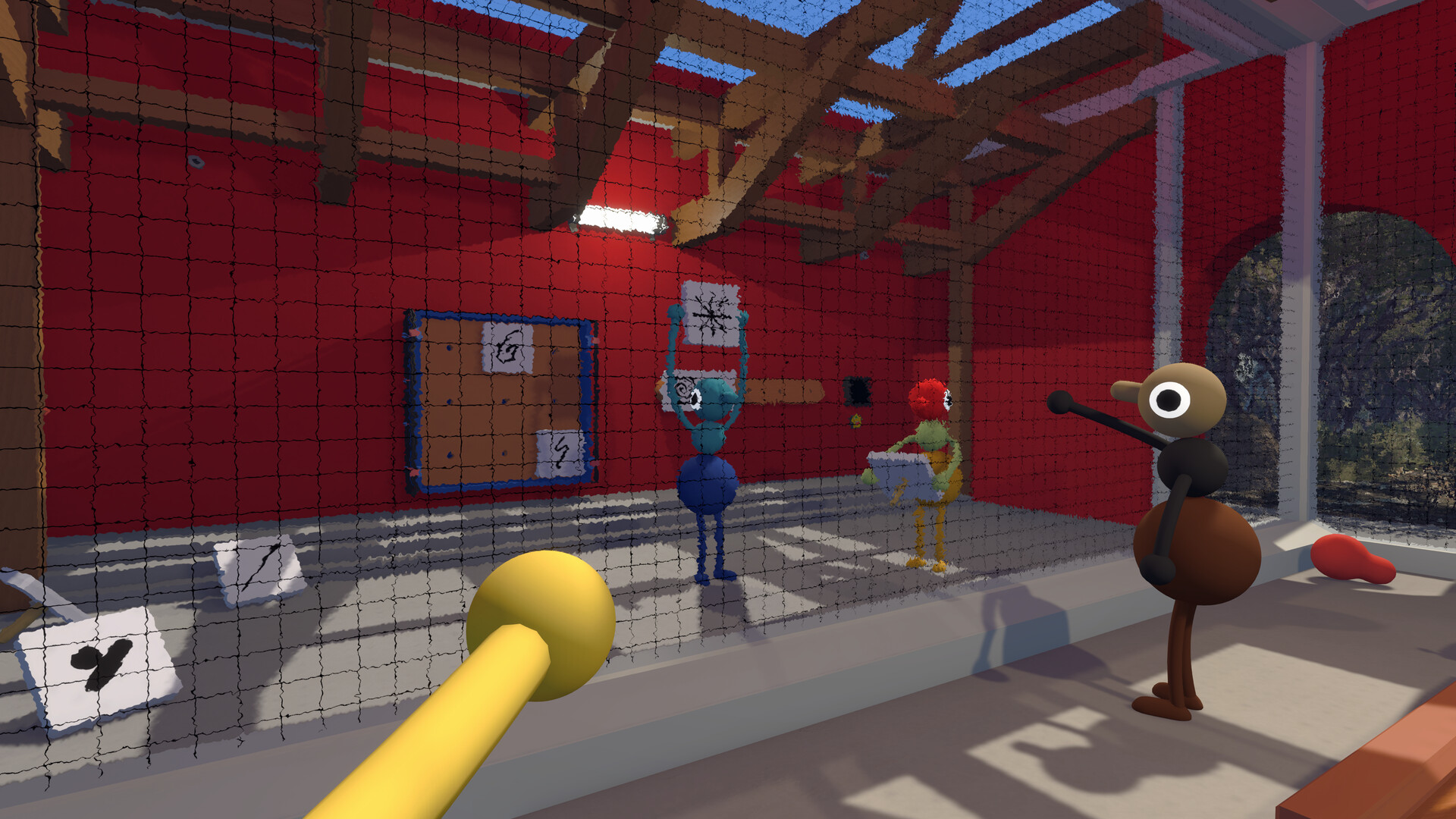
Many of Big Walk’s puzzles are description exercises. One player gets locked in a room with a pattern on a display, and someone outside recreates that pattern on a pegboard from spoken instructions alone. The Blue Room near the drawbridge and the Green Room in the Red Tower both work this way.
Others block the voice channel entirely. Soundproof glass appears in more than one puzzle, and PC Gamer’s writeup describes a session where three players fell back on arm-raise sequences through the glass, then lost the signal when night fell and one of them blended into a green wall he had painted himself to match earlier. Banging on the glass did nothing.
The Mountain Gesture puzzle at the Red Tower runs the exchange in the other direction. One player watches five platforms through telescopes while another travels to each platform and performs the gesture shown there, and the watcher picks the matching gesture card. Bring binoculars for the traveler before you start.
Lobby Size Changes Which Puzzles You Get
The player-count setting in your lobby controls which puzzles spawn and how many inputs they need, not only how many people can join. A two-player session gets a two-button version of the same puzzle a four-player session gets with four buttons. Some puzzles need four players to exist at all.
Set the lobby size to match the group actually playing. Leave it at four while two of you play and puzzles requiring four players will spawn in your world with no way to finish them. One duo on r/BigWalk worked through a two-player symbol puzzle by having the player with the speaker read symbols aloud while the other flashed a light on the correct one, after a guide written for the three-player version left them stuck.
Why You Keep Losing the Walkie-Talkie
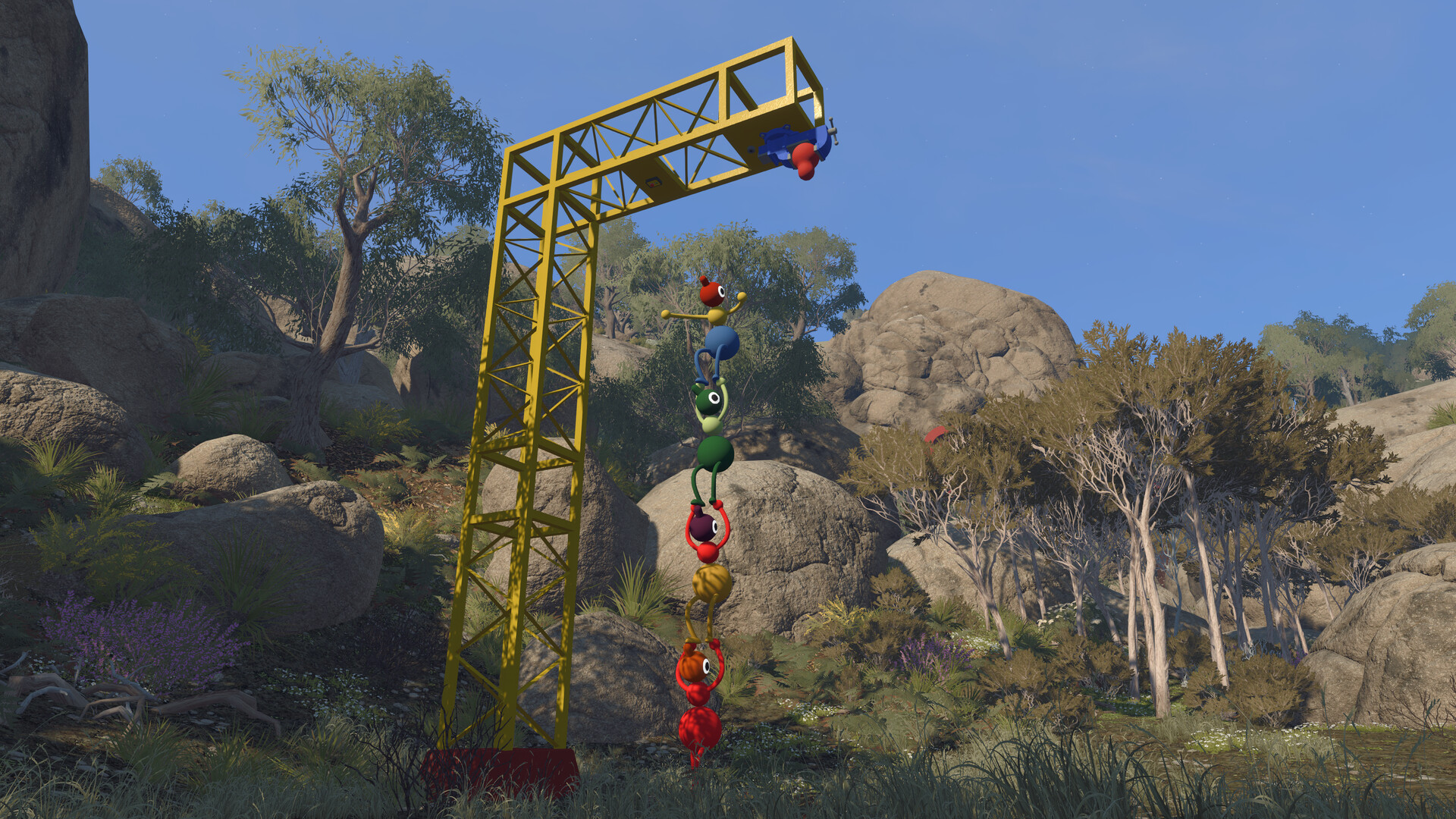
There is no inventory. You hold one item at a time in your hands, and picking up anything else means putting the first thing down. A walkie-talkie occupies the same slot as the flashlight, the binoculars, and the puzzle reward you are carrying home.
Take a tumble and you drop what you were holding. It can bounce into undergrowth or over the side of a mountain, which is how one PC Gamer session lost a fresh pair of binoculars off the top of a tower. Accessories change this: backpacks and holsters turn up as you explore and let you carry more than one thing.
Until your group finds carrying accessories, the person going furthest holds the walkie-talkie and nothing else, and someone staying central holds the light.
The Quiet Voice Patch and What Still Breaks
Big Walk shipped with a voice volume problem. Some players came through far quieter than intended even at close range, and House House acknowledged it on Steam two days after launch. Version 1.4.8 landed on Steam on August 7, 2026, with the console versions following later.
The patch raises quiet microphone setups toward the intended volume. It takes a moment to calibrate, so if someone sounds faint the instant they join, have them keep talking for a few seconds. Anyone who cranked their system volume to compensate before the patch should turn it back down.
The distance was left alone deliberately. “We have not changed the distance at which voices drop off,” House House wrote. “We consider it an important part of the game’s design that you can only hear players who are close to you. This distance is quite specific and shapes the dynamics of the game, the same way that a character’s jump height might be very specific in a platforming game.” The patch also did not add separate sliders for voice and background audio.
One issue is still open. A thread on r/BigWalk collects reports of voices stuttering and cutting out on both proximity chat and walkie-talkie audio while every other sound plays cleanly, with players describing it on Mac and Windows after the update and one saying their Switch 2 session was unaffected. That is a handful of players in a single thread rather than a measured figure, so treat it as a known report and not a diagnosis.
Set a Lobby Password Before You Start
Do this before your first session. Big Walk manages lobbies through Epic Online Services, and a community PSA thread documented that join codes can be queried in bulk, with a Thunderstore mod that lists open lobbies as the proof. The join system looks private. It is not.
Players in that thread describe strangers arriving mid-session. Some were friendly, one group ended up building a totem with three Spanish players who wandered in, and others report figures following them silently or signaling in Morse code from towers. A password closes the lobby, and setting the player count lower does not, because that setting sizes the puzzles rather than capping the room.
Why Discord Ruins It
Big Walk warns you about this on first launch. Running your group through Discord or console party chat gives everyone perfect audio at unlimited range, which removes the constraint every puzzle above is built around. The soundproof glass stops being a puzzle. The walkie-talkie becomes a prop.
Players police it too. A post on r/BigWalk showing a group using party chat drew a run of replies that all said the same thing in progressively fewer words, ending at “kills game”. House House built the in-game text chat as the accessible alternative so nobody needs an outside app.
House House has no post-launch content planned. In their Reddit AMA the studio suggested making your own games in the world instead, and said they had good results playing hide-and-seek among themselves. If that appeals, our prop hunt and hide-and-seek picks for game night cover games built around the same idea.
Gear for Hearing Every Word
In Big Walk the faint, distance-attenuated voice is the information you are playing on. A headset that resolves a quiet voice at medium range earns its place, and a microphone that transmits at a healthy level answers the problem House House patched around. Prices checked August 2026.

HyperX Cloud Alpha Wireless
300-hour battery and a noise-cancelling mic, down 46 percent from $199.99. Long sessions without a charge cable.

HyperX Cloud Alpha
Wired, with a detachable mic, and rated for PC, PS5, Xbox, Switch and mobile. Useful when the group spans platforms.

Razer Seiren V3 Mini
A supercardioid condenser at 33 percent off, for anyone whose voice still lands quiet after the 1.4.8 patch.
Frequently Asked Questions
How far does voice chat reach in Big Walk?
Only a few yards at full clarity. Voices fade quickly with distance, muffle through walls, and echo in corridors. PC Gamer’s Tyler Wilde described the practical limit as roughly the distance at which you could still hold a casual conversation in real life, around 25 feet in the open.
How many walkie-talkies does a group need in Big Walk?
Two cover a four-player group that moves in pairs, and a twelve-player lobby is better served by three spread across sub-groups so each cluster keeps a link back to the host. They all share one channel, so color does not matter when you hand them out.
Can you play Big Walk without a microphone?
Yes. House House states that Big Walk’s in-game text chat has the same features as the voice chat, and that you can play the whole game that way without missing out. Gestures, laser pointers, signs and flashlight signals all work without speech too.
Why can’t my friends hear me in Big Walk?
Check distance first, since the falloff is steep and walls block sound. If you are close and still faint, update to version 1.4.8 or later, which raises quiet microphone setups toward the intended volume. That fix takes a few seconds of talking to calibrate after you join.
Can strangers join my Big Walk lobby?
Yes, unless you set a password. Big Walk handles lobbies through Epic Online Services, and a community PSA thread documented that join codes can be queried publicly. Lowering the player-count setting does not close the lobby, because that setting controls which puzzles spawn.
Does using Discord break Big Walk?
It removes the central constraint. Several puzzles are built around players being unable to hear each other, including rooms separated by soundproof glass, and unlimited-range outside voice chat solves them for free. The game warns you against it on first launch.
Summary
Big Walk gets hard when you can see a teammate but cannot reach them with your voice. Carry a walkie-talkie for planned splits, a light for the night and for flash codes, and binoculars for anyone reading a teammate at range. Agree on a name for the puzzle rewards and a yes-or-no flash code before you separate. How to Fish followed on August 20 with a different co-op problem, and our How to Fish money guide covers the Killscore and cooking multipliers that decide what a catch is worth.
Two settings are worth changing before you play: set the lobby password so nobody wanders into your session, and set the player count to the number of people actually in it so the puzzles match your group. Big Walk sold a million copies in its first week and sat near the top of the Steam charts through August, which puts it alongside the other most-played games on Steam right now. If you are lining up a group session, our Halo co-op and crossplay breakdown covers a very different way to play together.