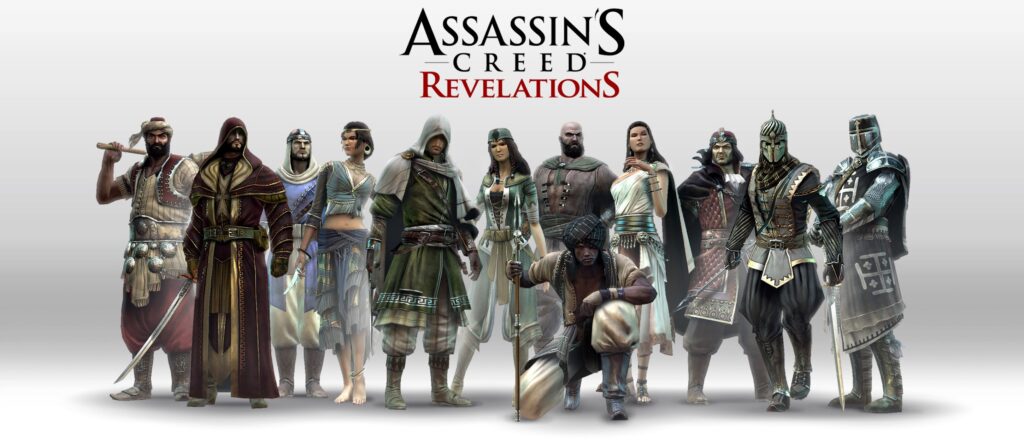
Assassin’s Creed Revelations
The weakest game in the Ezio trilogy, but Constantinople is gorgeous, the Altair flashbacks add real depth, and Ezio’s farewell still lands harder than most modern game endings. Worth playing for the story. Skip the tower defense.
TL;DR
Assassin’s Creed Revelations is carried by its setting and its story. Constantinople is one of the best cities in the franchise. The Altair flashback sequences connect two generations of assassins in a way no other AC game has matched. Ezio’s final monologue is genuinely moving. The gameplay additions (bombs, tower defense) mostly get in the way. If you care about the Ezio trilogy, play it. If you’re burned out on AC’s formula, this won’t fix that.
What Is Assassin’s Creed Revelations?
Assassin’s Creed Revelations is the fourth major entry in the Assassin’s Creed series and the third and final game starring Ezio Auditore. Developed by Ubisoft Montreal and released in November 2011, it launched on PS3, Xbox 360, and PC. The game sits at 80 on Metacritic, which puts it below Assassin’s Creed 2 (90) and Brotherhood (89) but above most of the series entries that followed.
The story picks up where Brotherhood left off. An aging Ezio, now in his early 50s, travels to Constantinople (modern-day Istanbul) to find five keys hidden by the legendary assassin Altair Ibn-La’Ahad. These keys unlock a library beneath the fortress at Masyaf that supposedly holds a weapon powerful enough to end the war between Assassins and Templars for good. Along the way, Ezio gets tangled in Ottoman politics, falls for a Venetian bookshop owner named Sofia Sartor, and confronts Templar agents working within the Byzantine remnant.
It was also the last time the series had a clear emotional core before the franchise shifted to open-world RPGs with Origins. For better or worse, this is where Ezio’s story ends.
Constantinople and the Hookblade
Constantinople is the best thing about Revelations. Where Rome in Brotherhood felt sprawling but samey, Constantinople is dense and visually distinct. The city sits at the crossroads of Europe and Asia, and Ubisoft leaned into that contrast. The Galata district feels European with stone buildings and wide streets. Cross the Golden Horn into the Imperial district and the architecture shifts to domed mosques, covered bazaars, and narrow alleys packed with merchants. The rooftop skyline is cluttered with minarets, chimneys, and hanging gardens.
The hookblade is the traversal upgrade that makes it all work. Ezio’s getting old, and the hookblade compensates by letting him grab ledges from further away, climb roughly 30% faster, and launch off ziplines strung between rooftops. Ubisoft built Constantinople around these ziplines, and the result is a city that’s genuinely fun to traverse. Once you unlock a few Assassin dens and the zipline network fills in, getting across the map feels smooth and fast in a way Brotherhood’s horseback rides never managed.
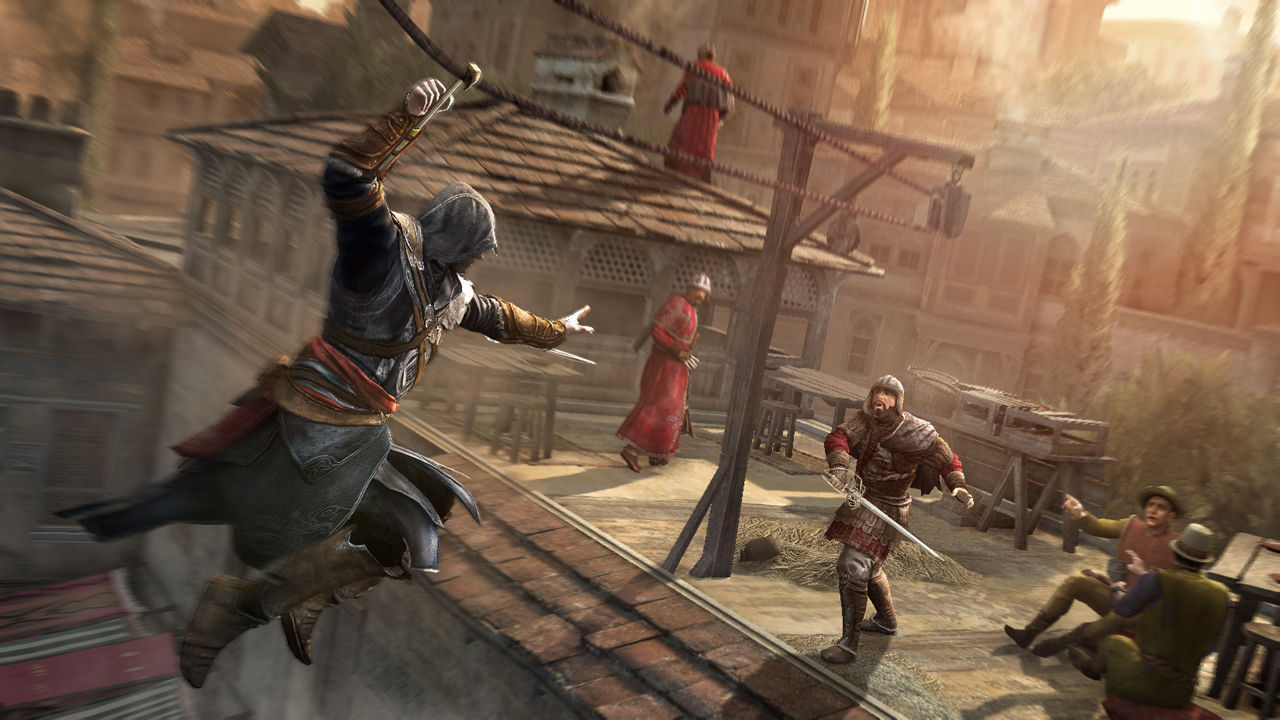
In combat, the hookblade adds a grab-and-yank move that lets you pull enemies off balance for a follow-up kill. It’s not deep, but it keeps the flow moving. Combined with the existing counter-kill system from Brotherhood, fights still feel snappy even if they’re never challenging. You’re not playing this game for the combat. You’re playing it for the rooftops.
The Tower Defense Problem
Every discussion about Revelations eventually circles back to the den defense. If your Templar awareness gets too high, your assassin dens can be attacked, and you’re pulled into a tower defense minigame where you place archers, barricade fighters, and riflemen on rooftops to hold off waves of soldiers. It’s clunky and completely at odds with the rest of the game’s pace.
The community consensus hasn’t changed since 2011: den defense is the worst thing in the game. Steam forums, ResetEra, and NeoGAF threads from every era call it “goofy,” “tacked on,” and “unnecessary.” The good news is that it’s almost entirely avoidable. Only the first defense is mandatory. After that, if you assign Master Assassins to each den, they become immune to attack. Most players who enjoy the game learned to do this early and never touched den defense again.
Bomb crafting is the other new mechanic, and it splits opinions more evenly. There are roughly 15 bomb types spanning lethal, tactical, and diversionary categories. You can craft smoke bombs, cherry bombs that attract guards, tripwire mines, and shrapnel explosives. In theory, it adds planning and creativity to encounters. In practice, the basic smoke bomb and a hidden blade handle 90% of situations, so most of the crafting system goes unused. It’s not bad, just unnecessary.
This is where the franchise fatigue argument lives. Revelations shipped one year after Brotherhood, which shipped one year after AC 2. Three annualized releases in a row meant Ubisoft was adding features to justify the sequel rather than improving the foundation. The AC Unity review we published covers what happened when that approach finally collapsed. Revelations is where the cracks started showing.
Ezio’s Farewell
For all the mechanical bloat, the story is what carries this game. And the Altair flashback sequences are the secret weapon.
Each of the five keys Ezio finds contains a memory seal, a recording of a key moment in Altair’s life. These aren’t cutscenes. They’re playable sequences set in Masyaf across different decades, showing Altair’s rise to Mentor, his exile, the loss of his family, and his final years guarding the Apple of Eden. Played back to back, they form a complete second story running parallel to Ezio’s.
What makes it work is the mirroring. Ezio is old and questioning whether his decades as an assassin meant anything. The Altair flashbacks answer that question by showing a man who faced the same doubt centuries earlier. When Ezio finally enters Altair’s library and finds his remains sitting in a chair, Apple of Eden in hand, the weight of both lifetimes hits at once.
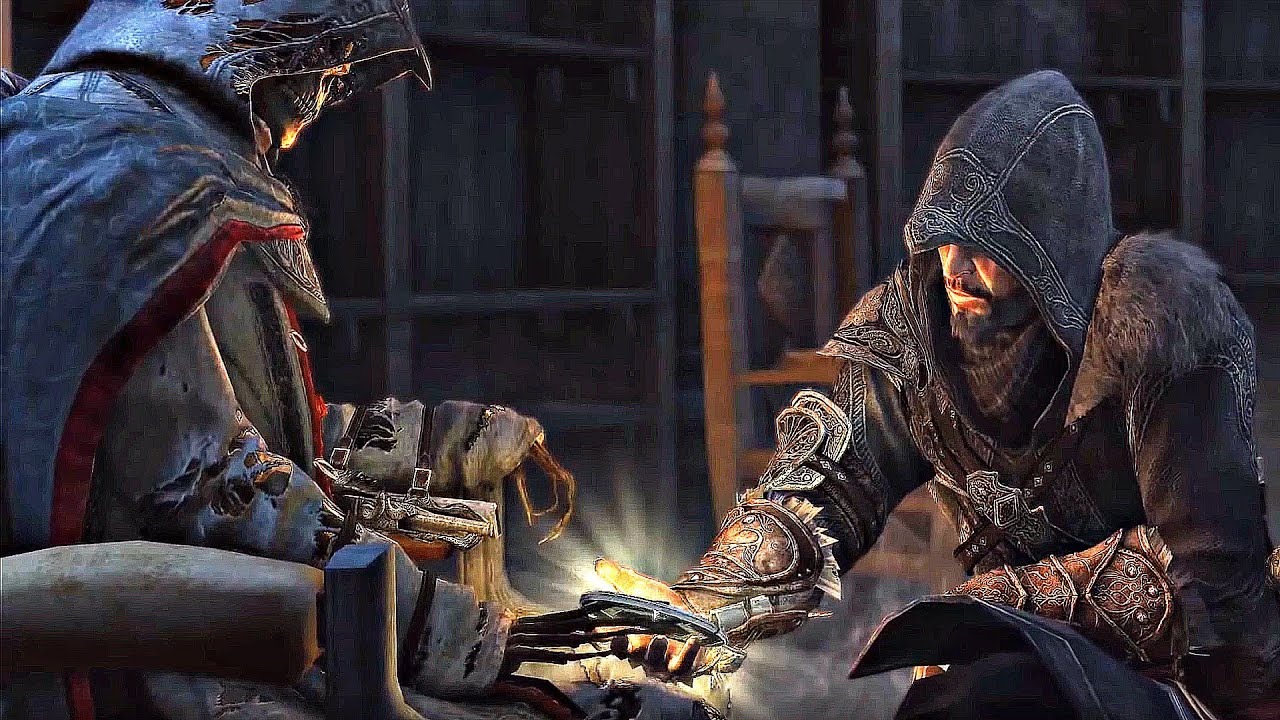
Then comes the monologue. Ezio, standing in the library, speaks directly to Desmond: “I heard your name once before, Desmond, a long time ago. And now it lingers in my mind like an image from an old dream. I do not know where you are, or by what means you can hear me. But I know you are listening.” He removes his hidden blades and sword, places them on the floor, and walks away. No boss fight. No dramatic escape. Just a man deciding he’s done.
It remains one of the strongest character moments in the franchise. The scene works because Ezio earned it across three full games. You watched him grow from a teenage brawler in Florence to a master assassin in Rome to a weary old man in Constantinople, and the goodbye feels earned in a way that few game trilogies manage.
Desmond’s Journey
The modern-day sections are the most polarizing part of the game. Desmond’s mind is trapped in the Animus core (called “Animus Island”), and his sequences are first-person platforming puzzles built from geometric shapes. They play like a low-budget Portal without the humor, where you place blocks and bridges to navigate abstract environments while Desmond narrates his life story before the events of AC 1.
The narration itself is fine. Learning about Desmond’s childhood, his escape from the Assassin compound, and his years as a bartender adds context to a character who was always the weakest link in the series. The problem is that the gameplay surrounding it is tedious. The platforming is imprecise and the levels drag on. The whole thing feels like it belongs in a different game.
Most players either loved the lore dumps and tolerated the puzzles, or skipped the sequences entirely (they’re optional). If you’re replaying in 2026 and care about the modern-day storyline’s trajectory through AC 3, they’re worth doing once. Otherwise, you can safely ignore them.
Recommended Gear
Revelations is best experienced with a controller. The combat and parkour systems were designed for analog sticks, and keyboard controls have always felt awkward in the Ezio trilogy. If you’re playing on PC and need a solid option that works across platforms, the 8BitDo Pro 2 is a reliable pick.

Hall effect sticks, Bluetooth and USB-C, works with PC, Switch, Android, and iOS. Remappable back buttons and a solid D-pad for menu navigation. Under $50 and punches well above its price.
Frequently Asked Questions
Is Assassin’s Creed Revelations worth playing in 2026?
Yes, if you care about Ezio’s story. Constantinople is a great setting, and the ending is one of the best in the franchise. If you’re already burned out on the AC formula, Revelations won’t change your mind since it doesn’t fix any of the series’ core issues.
Can you skip the tower defense in AC Revelations?
Mostly. The first den defense is mandatory, but after that you can avoid them entirely by assigning Master Assassins to each den. Once a den has a Master Assassin, it becomes immune to attacks and you never see tower defense again.
Do you need to play AC 2 and Brotherhood before Revelations?
Strongly recommended. Revelations is the conclusion to a trilogy. Ezio’s farewell only hits if you’ve followed him from AC 2. The Altair sequences also reference events from the original Assassin’s Creed.
What platforms is AC Revelations available on?
PS3, Xbox 360, and PC (via Steam and Ubisoft Connect). It’s also playable on PS4/PS5 through The Ezio Collection remaster and on Xbox One/Series X through backward compatibility. The PC version goes on sale regularly for around $6.
How long is Assassin’s Creed Revelations?
The main story takes about 12-15 hours. Completing all side content (den defense, bomb crafting challenges, Desmond’s Journey, collectibles) pushes it to 25-30 hours. Most players finish the story in a weekend.
Final Verdict
Assassin’s Creed Revelations is the weakest game in the Ezio trilogy, and that reputation is deserved. The den defense is a misfire. Bomb crafting is filler. The annualized development cycle left visible seams. But none of that erases what the game gets right: Constantinople is beautiful, the hookblade makes traversal satisfying, the Altair flashbacks are some of the best storytelling in the franchise, and Ezio’s farewell is a genuinely great ending.
If you’re replaying the Ezio trilogy and wondering whether to skip Revelations, don’t. The story payoff is worth the mechanical rough edges. Just assign your Master Assassins early, ignore most of the bomb crafting menu, and let Constantinople and the narrative do the heavy lifting.
At $6 on PC, the price of entry is low enough that the farewell alone is worth it.
This is part of /SKILL’s Retro Review series, where we revisit the games that shaped the medium. Read our Chrono Trigger retro review, our Dungeon Keeper retro review, or our Resident Evil Revelations retro review for more classics worth revisiting.
Assassin’s Creed Revelations
The weakest Ezio game, but Constantinople is gorgeous and Ezio’s farewell still hits harder than most modern game endings. Worth playing for the story alone.