⚡ Quick Verdict
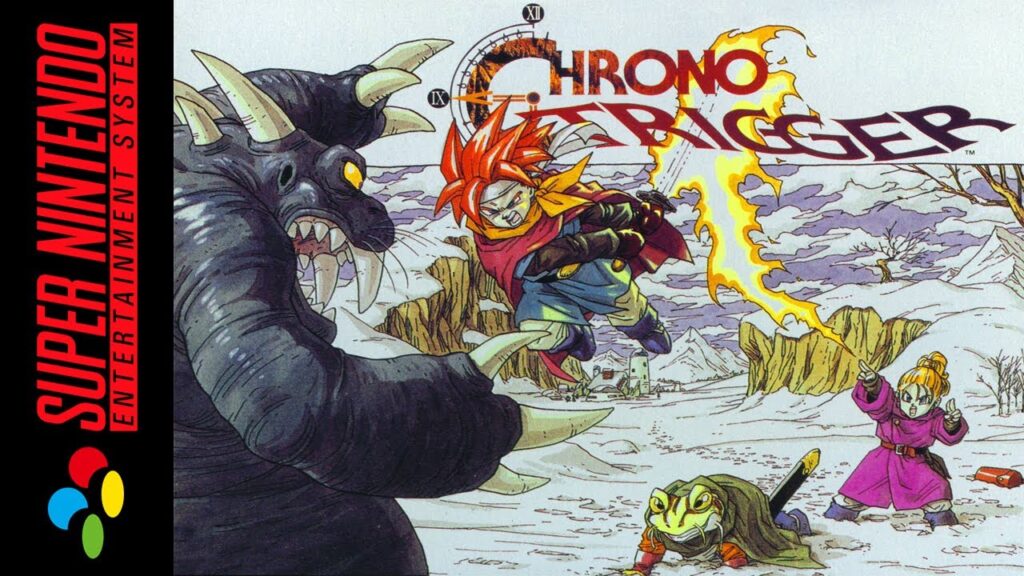
Chrono Trigger is a 10/10 RPG that hasn’t aged a day. Thirty years after release, its time travel narrative, battle system, and soundtrack still outclass most modern RPGs. If you haven’t played it, fix that immediately.
📋 In This Review
I’ve been putting off writing this Chrono Trigger review for a while. Not because I don’t know what to say, but because there’s a strange pressure that comes with reviewing something this widely loved. How do you write about a game that regularly tops “greatest of all time” lists without just repeating what everyone already knows?
Here’s my attempt. This is a genuine critical look at why Chrono Trigger, originally released in 1995 for the Super Nintendo, still holds up in 2026. Not a nostalgia trip. Not a victory lap. An honest look at a game that got almost everything right, and still does.
This is also the first entry in /SKILL’s new Retro Review series, where we’re going back to the games that shaped the medium and asking: do they actually hold up, or are we just being sentimental? Chrono Trigger felt like the right place to start. If you’re a fan of classic RPGs, you’ll want to check out our SNES top list for more from this era.
The Dream Team Behind the Legend
Chrono Trigger’s development story sounds like fan fiction. In October 1992, three of the biggest names in Japanese gaming decided to make a game together: Hironobu Sakaguchi, creator of Final Fantasy; Yuji Horii, creator of Dragon Quest; and Akira Toriyama, the artist behind Dragon Ball and the Dragon Quest character designs.
Square called them the “Dream Team,” and for once, the marketing wasn’t exaggerating. These three traveled to the United States to research computer graphics, then came back and decided to build “something no one had done before.” Kazuhiko Aoki came on as producer, and after four days of brainstorming, a team of 50-60 developers started building the game in early 1993.
What makes this collaboration special is that you can feel each creator’s fingerprints on the final product. Horii’s tight scenario design keeps the pacing sharp. Sakaguchi’s RPG sensibility gives the systems their polish. Toriyama’s character art gives every party member instant personality. The game wouldn’t work without any one of them.
Masato Kato wrote most of the story, sketching out the original character concepts that Toriyama then refined. One detail I love: Kato’s original sketches included an old sage character and a monster man. The sage got cut entirely. The monster man became Frog, one of the most beloved characters in RPG history. Sometimes the best design choices come from iteration.
Time Travel Done Right
Plenty of games use time travel. Most treat it as a plot device to move you between levels. Chrono Trigger builds its entire design around it.
You have access to seven time periods: 65,000,000 BC (dinosaurs and prehistoric humans), 12,000 BC (the magical Kingdom of Zeal floating above an ice age), 600 AD (medieval knights vs. an army of monsters), 1000 AD (the present day, where the game begins), 1999 AD (the apocalypse), 2300 AD (a ruined future where humans survive in underground domes), and the End of Time (a hub area outside normal time).
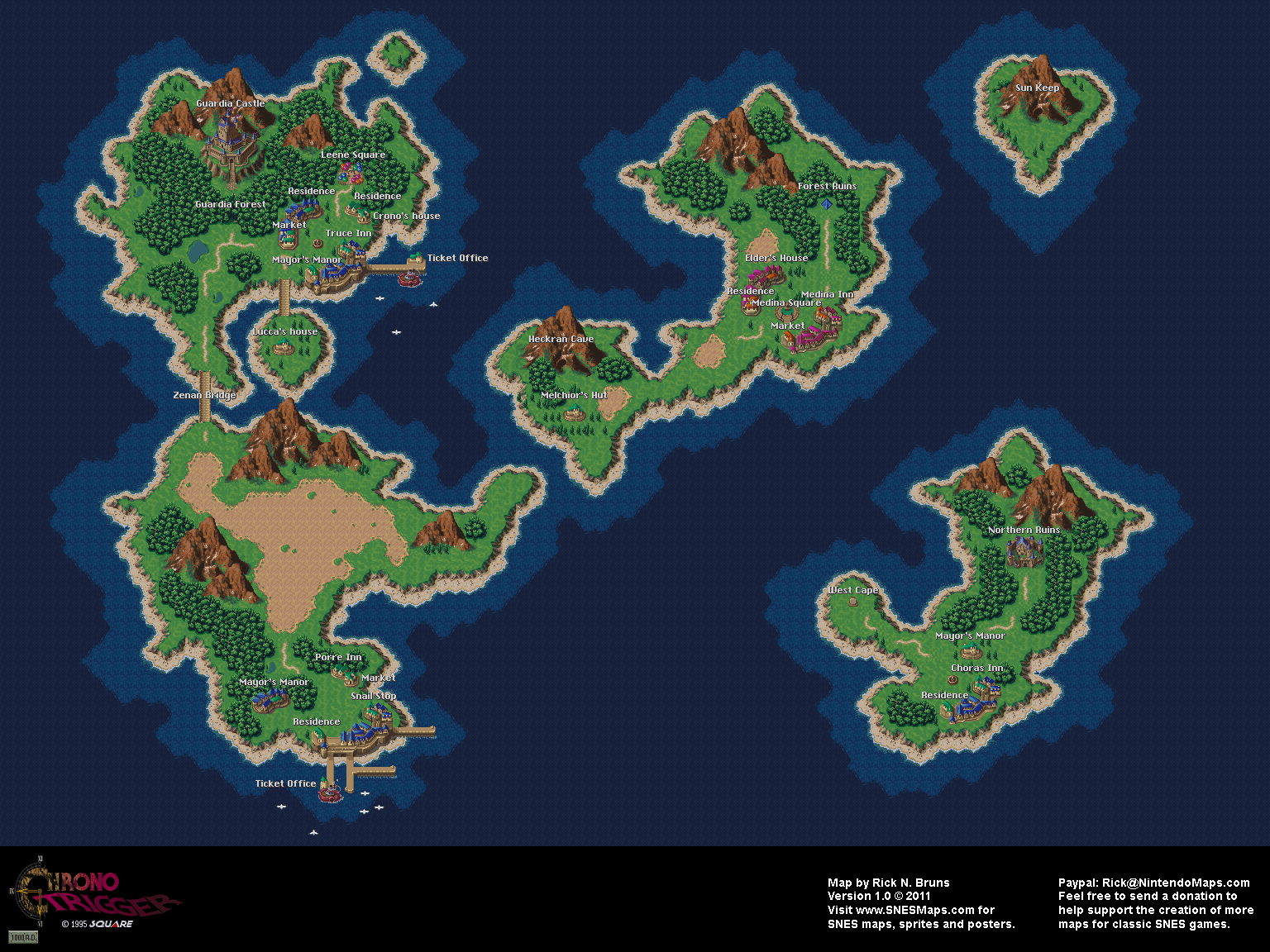
What makes it work is cause and effect. Actions you take in one era ripple forward through time. Help someone in 600 AD, and their descendants remember in 1000 AD. Destroy something in prehistory, and it’s gone everywhere after. The game trusts you to notice these connections without always spelling them out, and that moment of realization when you see how a past action shaped the future is one of the best feelings in gaming. RPGFan’s original review nailed it: “One of the greatest feelings I have ever experienced playing a video game is the sudden realization of how a past event affected the future.”
The plot itself follows Crono and his friends as they discover that a parasitic alien called Lavos will destroy the world in 1999 AD. To stop it, they have to travel across every era, gathering allies, unraveling conspiracies, and slowly piecing together where Lavos came from and why it’s been feeding on the planet’s energy for millions of years. The story starts small (a teleporter accident at a fair) and escalates to the literal fate of the world without ever feeling rushed.
A Battle System That Respects Your Time
In 1995, random encounters were the norm. You’d walk three steps in a dungeon and get yanked into a separate battle screen to fight enemies you couldn’t see coming. It was tedious then. It’s brutal now.
Chrono Trigger said no to all of that. Enemies are visible on the field map. You can often avoid them. When you do fight, the battle happens right there on the same screen, no transition. This sounds basic by modern standards, but in 1995 it was a genuine design breakthrough for turn-based RPGs.
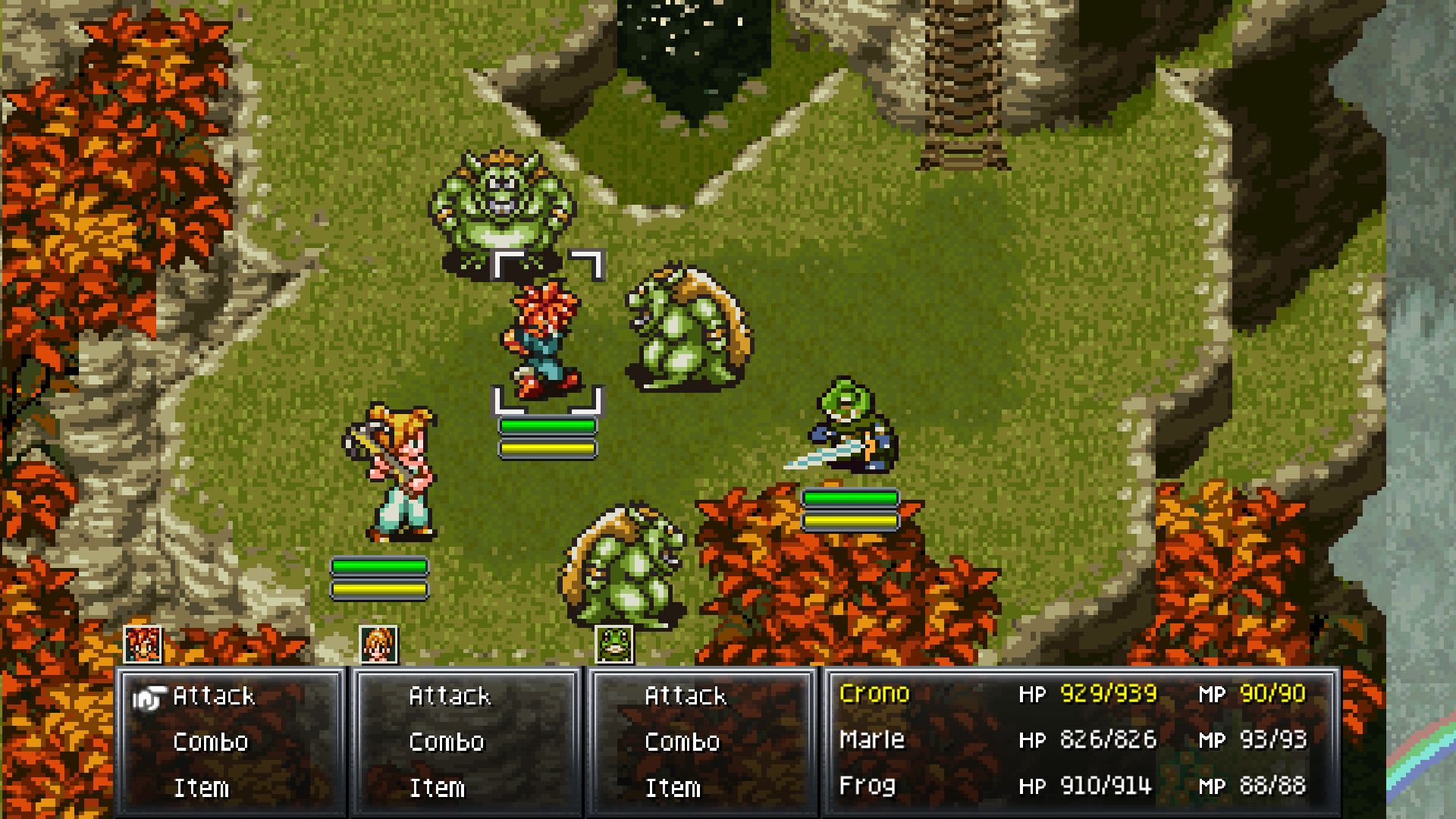
The combat itself uses Active Time Battle 2.0, a refined version of the system from Final Fantasy. Each character has a timer that fills based on their speed stat. When it’s full, you pick an action: Attack, Item, or Tech.
Techs are where the system gets interesting. Every character has eight personal Techs (special abilities and magic), but you can also combine Techs between two or three party members to create Dual and Triple Techs. Crono’s Cyclone plus Lucca’s Flame Toss creates Fire Whirl. Crono’s sword slash plus Marle’s ice magic creates a frozen blade that hits like a glacier. The game automatically shows combo options when compatible characters have enough MP, so you’re always discovering new combinations as your party evolves.
Enemies also move around during battle, which matters because many Techs have area-of-effect zones. A spell that hits clustered enemies is useless if they’ve spread out. This adds a light tactical layer where timing your attacks for optimal positioning is genuinely satisfying.
The difficulty balance deserves special mention. You never need to grind. The game keeps things challenging enough to stay engaging without ever forcing you to circle a map fighting the same enemies for an hour. That’s a design achievement that plenty of modern RPGs still can’t match.
Characters You Actually Care About
Chrono Trigger gives you seven playable characters, each from a different time period, and somehow makes most of them memorable with relatively little dialogue. This is especially impressive when you consider that Crono, the protagonist, never speaks a single word.
The silent protagonist thing usually bothers me. Here, it works. Crono communicates through actions and expressions, and the supporting cast is strong enough to carry the story. Marle is a princess who hates being treated like one. Lucca is an inventor whose genius is constantly getting the party into and out of trouble. Frog is a cursed knight wrestling with guilt over his failure to save his friend Cyrus. Robo is a robot from the ruined future who gradually develops something close to a soul, eventually pondering the existence of an “entity” that might be guiding events through time.
Then there’s Magus. Initially presented as the villain of the 600 AD arc, the game slowly reveals him as Prince Janus of Zeal, separated from his sister Schala when Lavos scattered the kingdom across time. He spent years building power to take revenge on the creature that destroyed his home. The game lets you choose whether to kill him, duel him with Frog, or recruit him as a party member. That kind of moral complexity was rare for a 1995 SNES game.
Ayla rounds out the cast as the prehistoric chief who fights with her bare fists and is the strongest physical attacker in the party. She’s straightforward in a way that contrasts well with the more complicated characters.
Each character also has a personal sidequest in the late game that digs deeper into their story. Frog puts Cyrus’s ghost to rest. Lucca gets a chance to prevent the accident that disabled her mother. Robo spends 400 years restoring a forest. These sidequests are optional, but they’re some of the best content in the game. The Frog and Lucca ones in particular are genuinely emotional.
The Soundtrack That Changed Everything
The Chrono Trigger soundtrack is Yasunori Mitsuda’s masterpiece. It’s also the project that nearly destroyed him.
Mitsuda was a sound programmer at Square, unhappy with his pay, who threatened to leave unless he got to compose. Sakaguchi suggested he score the upcoming Chrono Trigger. It was his first major composition project. He poured everything into it, sleeping in his studio for stretches and using leitmotifs of the main theme to weave consistency across 64 tracks spanning three discs.
Then his hard drive crashed and he lost around 40 in-progress tracks.
He rebuilt. Then he developed stomach ulcers from the stress and overwork. Nobuo Uematsu, the legendary Final Fantasy composer, stepped in to finish 10 tracks so the game could ship. Noriko Matsueda contributed one track, “Boss Battle 1.” When Mitsuda finally returned to watch the completed ending sequence with the staff, he cried.
You can hear the obsession in the music. “Wind Scene” (the 600 AD overworld theme) is one of the most beautiful pieces ever composed for a video game. “Corridors of Time” captures the mystical sadness of the Kingdom of Zeal. “Frog’s Theme” turns a cursed knight’s story into something heroic. “Boss Battle 2” genuinely makes you feel like the world depends on what happens next. And “To Far Away Times,” the ending theme, is the kind of piece that makes you sit through the credits even when you’ve beaten the game five times.
The soundtrack won Best Music in a Cartridge-Based Game from Electronic Gaming Monthly in 1995 and has been consistently ranked among the best video game soundtracks ever made. It’s spawned multiple official albums, including an orchestral arrangement in 2008 and a 20th anniversary album, “To Far Away Times,” in 2015. If you want more on the musical legacy, we covered the Chrono Trigger symphony album release when it dropped.
One honest note: Uematsu’s 10 tracks are noticeably different in style from Mitsuda’s work. They’re solid compositions, but they lack the emotional specificity that makes Mitsuda’s tracks so memorable. It’s the one place where the collaborative nature of the project creates a slight inconsistency.
New Game+ and 13 Endings
Chrono Trigger invented New Game Plus. The concept that’s now standard across dozens of genres started here. After beating the game, you can restart with your leveled-up characters, equipment, and Techs intact. Story items get removed so you still progress through the narrative, but you’re powerful enough to blow through early content and focus on reaching different endings.
And there are a lot of endings. The original SNES version has 12. The DS, iOS, Android, and Steam versions have 13 (the DS version added new content that ties into the sequel, Chrono Cross). Which ending you get depends on when and how you defeat Lavos. You can challenge the final boss at almost any point after reaching a certain story milestone, and the ending changes based on where you are in the narrative.
Beat Lavos early with an overpowered New Game+ party and you’ll see endings that range from comedic to surreal. Follow the main story to its natural conclusion and you get the “canon” ending. There’s an ending where the development team breaks the fourth wall and talks directly to you. There’s one where Frog and Magus have their final confrontation. The variety rewards repeated playthroughs in a way that felt revolutionary in 1995 and still feels generous today.
The New Game Plus concept was later adopted by Chrono Cross, the Dark Souls series, Final Fantasy XV, Nier: Automata, and countless others. Every time you see that option on a title screen, Chrono Trigger is the reason it exists.
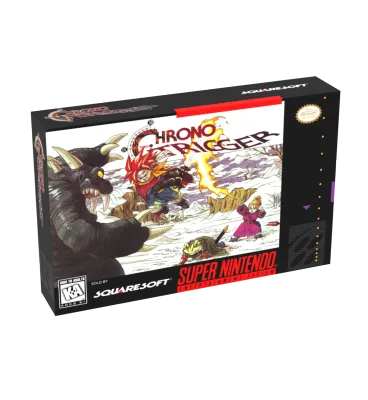
Chrono Trigger (SNES)
The one this review is about. Loose carts from $35, CIB from $180+.
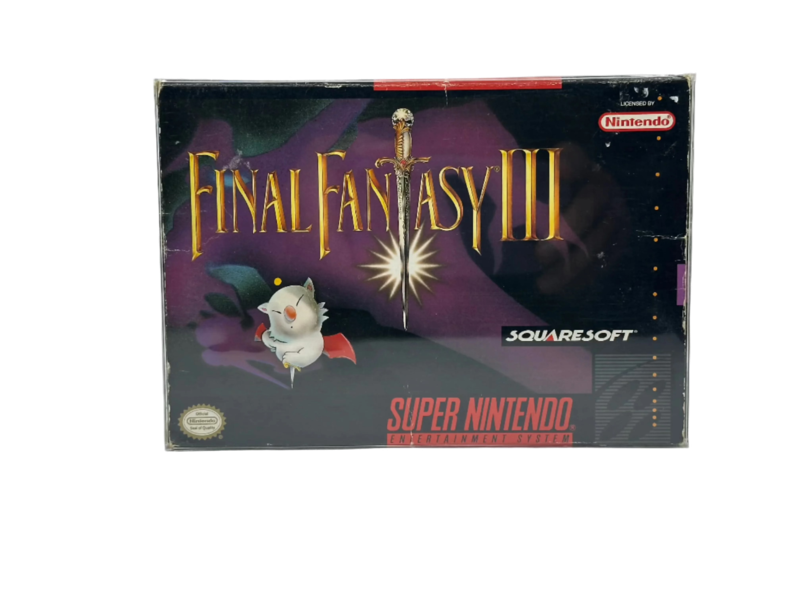
Final Fantasy III (SNES)
The other SNES RPG masterpiece. Known as FF6 in Japan. Kefka alone is worth the price.
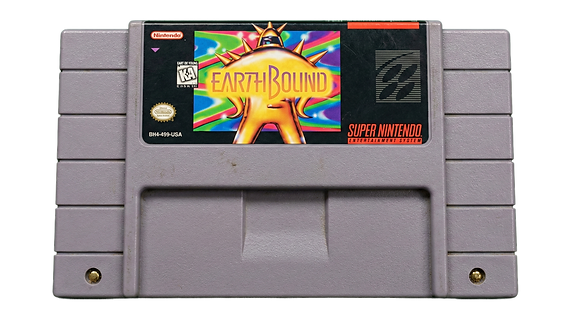
EarthBound (SNES)
The weirdest, most heartfelt RPG on the SNES. Expensive, but nothing else plays like it.
Where to Play Chrono Trigger Today
Chrono Trigger has been ported to nearly everything. Here’s a quick breakdown of your options:
| Platform | Notes | Recommended? |
|---|---|---|
| SNES (Original) | The classic experience with the original Ted Woolsey translation. No extras. | For purists |
| Nintendo DS | Retranslated script, extra dungeons, bonus ending that ties into Chrono Cross. Best overall version. | ✅ Best version |
| Steam/PC | Higher resolution, updated UI after patch fixes. Based on the mobile port but cleaned up significantly. | ✅ Great option |
| iOS/Android | Functional mobile port. Touch controls work fine. Same content as DS minus multiplayer arena. | Decent |
| PlayStation (Final Fantasy Chronicles) | Added anime cutscenes but notorious for load times before every battle. | Skip it |
If you’re playing for the first time, the DS version is the definitive experience. If you don’t have a DS, the Steam version is excellent after the patches Square Enix rolled out to fix the initial rough port. The mobile version is fine if that’s your only option, but a controller or physical buttons make the battle system feel better.
Frequently Asked Questions
Is Chrono Trigger still worth playing in 2026?
Absolutely. The pixel art holds up beautifully, the battle system is tighter than most modern RPGs, and the story respects your time with zero filler. A first playthrough runs about 20-25 hours, which is refreshingly compact by today’s standards.
What’s the best version of Chrono Trigger?
The Nintendo DS version is widely considered the best. It has a retranslated script, extra dungeons, a bonus ending, and retains the original pixel art without the UI issues that plagued the initial Steam/mobile ports.
How long does Chrono Trigger take to beat?
A standard playthrough takes about 20-25 hours. Completionists aiming for all endings can spend 50+ hours across multiple New Game Plus runs.
Is Chrono Trigger connected to Chrono Cross?
Yes. Chrono Cross is a sequel set in a parallel world, with plot connections to Chrono Trigger’s characters and events. The DS version of Chrono Trigger added an extra ending that directly bridges the two games. You don’t need to play one to enjoy the other, but playing Trigger first gives Cross more emotional weight.
Do I need to grind in Chrono Trigger?
No. The difficulty curve is balanced so that normal exploration and story progression give you enough experience. You’ll never need to circle a map fighting the same enemies to progress. It’s one of the best-paced RPGs ever made.
The Bottom Line
10/10 , Masterpiece
Chrono Trigger earned its reputation. Thirty years later, every design decision still holds up.
I went into this review looking for cracks. Something that would let me say “well, actually, it hasn’t aged perfectly.” And honestly? The cracks are cosmetic at best. The world map sprites are a little rough. The character development could go deeper in places. Uematsu’s tracks don’t quite match Mitsuda’s. That’s about it.
Everything else is as good as everyone says, or better. The time travel system is more thoughtfully designed than most modern games’ core mechanics. The battle system eliminated random encounters and screen transitions in 1995, years before the rest of the genre caught up. The Dual and Triple Tech system still hasn’t been meaningfully improved upon. New Game Plus exists because this game invented it. The soundtrack is one of the greatest ever composed for any medium, born from a young composer who literally worked himself sick to create it.
Chrono Trigger is 30 years old and it’s still the standard. That’s the review. That’s the whole review.
This is the first entry in /SKILL’s Retro Review series, where we revisit the games that shaped the medium. Next up: we’ll be looking at another SNES classic that redefined its genre. Stay tuned.