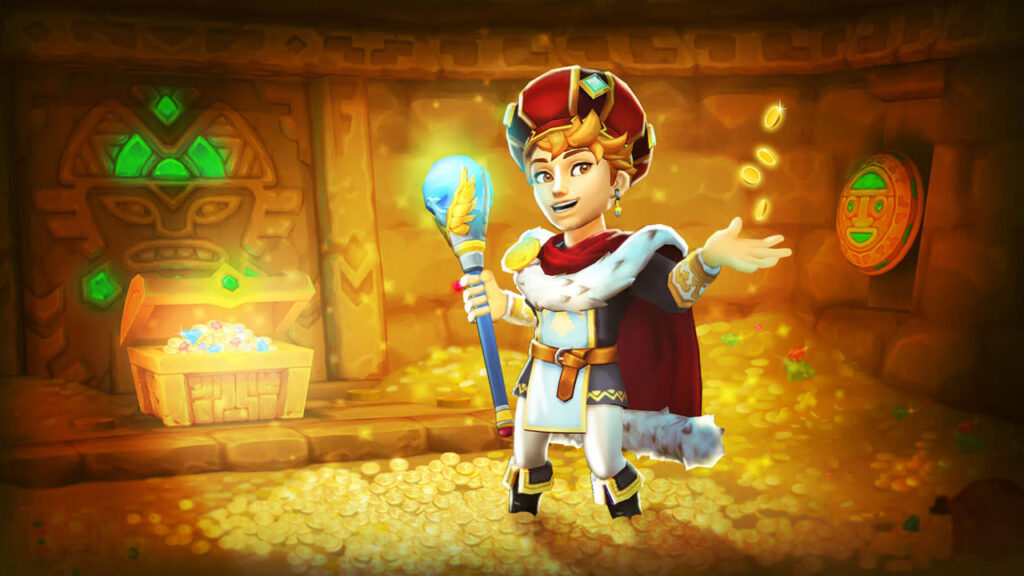
Making gold in Shop Titans changes dramatically as you progress. What works at level 20 becomes inefficient by level 50, and late-game strategies require setups that take months to build. This guide breaks down exactly how to maximize your gold income at every stage of the game.
Quick Answer
Early game (1-40): Use King bait with enchanted items. Buy chests for 2 gems and sell for gold. Sell low tier items on the market at 5-10x value.
Mid game (40-70): Optimize your crafting rotation. Surcharge T10-T11 items. Build your energy capacity.
Late game (70+): No-bin strategy with 4200+ energy. Buy from market, surcharge everything. 300-750 million gold per day.
Gold Fundamentals
Before diving into stage-specific strategies, understand these core mechanics:
Energy Management
Small talk gives you 10% of your remaining energy on success, but costs 7% of your total energy on failure. The optimal pattern:
- Below 2/3 energy: Small talk first, then discount
- Low energy: Surcharge first, then small talk
Discounting low-value items has a better energy-to-gold ratio than surcharging high-value items. Set a threshold (like 100k) where you surcharge above it and discount below half that value.
Counter Breakpoints
Your counter level determines how many customers can wait at once:
- Levels 1-5: 5 customers
- Levels 6-10: 8 customers
- Level 11+: 12 customers
Rush your counter to level 6, then 11. These are the biggest upgrades you can make for customer flow.
Customer Flow
Three factors control how fast customers arrive:
- Shop expansions: More squares = more customers (max 12 with all 9 squares)
- Counter level: Higher level = more waiting customers
- Rack items: Keep 90-105 items on display for max frequency
If any of these is low, it bottlenecks the others.
Early Game (Levels 1-40)
Your gold-per-hour is low, but so are your expenses. Focus on these strategies:
King Bait
The most lucrative early-game technique. King Reinhold pays 5x the base value of any item he purchases, making him your biggest source of gold until mid-game.
How King Bait Works
- Buy a high-value item (green quality or better) from the market
- Enchant it yourself with T2 enchants
- Lock all other items so only your bait is available
- Wait for King Reinhold to visit and buy it
The King can’t reach items that are locked or in chest mode. Use this to force him toward your prepared bait.
Best Items for King Bait
Target the highest base value items you can access. Platinum Cape is one of the best King bait items in the game. Always use a Limited Edition token when selling to the King — it doubles your surcharge for a 10x total multiplier.
Green (Superior) Platinum Cape:
- Base value: 59 million gold
- King sale (5x): 295 million gold
- With Limited Edition (5x × 2): 590 million gold
- With Reinhold Card (6x × 2): 708 million gold
- Market sourcing: You can sometimes find these for around 100 million if you’re lucky
Blue (Flawless) Platinum Cape:
- Base value: 94 million gold
- King sale (5x): 470 million gold
- With Limited Edition (5x × 2): 940 million gold
- With Reinhold Card (6x × 2): 1.128 billion gold
The Reinhold Card (from the card collection) increases King payouts from 5x to 6x base value. Combined with a Limited Edition token, a single blue Platinum Cape sale can net over 1 billion gold.
Kaipo the Baker (Premium Worker)
Kaipo is a premium worker unlocked at level 21 who handles Desserts. His ability is a game-changer for King bait strategies:
- King visits twice as often — roughly daily instead of every 1-2 days
- Sell two items per visit — double your income from every King appearance
With two blue Platinum Capes ready (both with Limited Edition tokens and the Reinhold Card bonus), you can earn up to 2.2 billion gold per King visit. Combined with more frequent visits, Kaipo can add over 1.4 billion gold per day to your income on top of everything else.
Check the Shop Titans spreadsheet to find the highest base value items at your current tier.
Enchanting for Profit
Always enchant your bait yourself rather than buying pre-enchanted items. T2 enchants sell at 3x their price increase on the market, but the King pays 5x. This margin is pure profit.
The King visits once every 1-2 days, making this ideal for casual play. Set your bait, lock everything else, and check back later.
Chest Flipping
One of the easiest early-game gold strategies: buy chests for 2 gems and sell them on the market for gold. These three chests offer the best gem-to-gold conversion:
Chest Value Table
| Chest | Cost | Market Sell Price |
|---|---|---|
| Limestone Chest | 2 gems | 1M |
| Forsaken Chest | 2 gems | 7.5M |
| Bleak Chest | 2 gems | 20M |
Bleak Chests are the sweet spot at 10M gold per gem. After a certain point in your progression, it won’t make sense to trade gems for gold this way — gems become more valuable for other uses like shop expansions and premium unlocks.
Market Selling
Sell T1-T3 items on the market for 5-10x their base value. Low tier items are always in demand from newer players who need them for bounties and tasks.
Power Leveling
If you want faster progression over gold:
- Sell crafted items in your shop
- Use that gold to buy more items from the market
- Surcharge expensive items, discount cheap ones
- Focus on XP, even at cost
This burns gold but accelerates your merchant level significantly.
Guild Priority
Leave your starting guild immediately and find an active one. Guild buildings are crucial because they increase worker/hero level caps, boost quest resources, and improve crafting regeneration. Your investments follow you if you switch guilds, so don’t worry about losing progress.
Mid Game (Levels 40-70)
This is where many players hit a wall. Low tier market selling doesn’t earn enough, but you can’t surcharge T13-T14 items yet.
The Mid-Game Problem
Common struggles at this stage:
- T10-T11 surcharging requires 2500+ energy and still feels slow
- You can craft T13-T14 but not surcharge them
- Gem-to-gold flipping becomes your lifeline
- Guild investments feel impossible (4G/month is considered low)
Crafting Optimization
The key is maximizing profit per craft slot. Follow these rules:
- Use all 4 base resources: Iron, wood, leather, herb
- One item per rare resource: You can only sustain 1 jewel item and 1 ether item due to regeneration rates
- Highest margin items: Pick the most profitable item for each resource type
- Master and ascend: Items must be mastered and 3-star ascended for maximum efficiency
An optimal crafting rotation nets 18-25 million gold per hour. Calculate your crafts-per-hour by dividing 60 by the minutes it takes for your slowest resource to regenerate enough for another craft.
Build Your Energy
Always be upgrading racks. Your goal is 4200+ energy for the late-game no-bin strategy. Every rack upgrade moves you closer to being able to surcharge higher tier items efficiently.
Save These Resources
- Caprice antique tokens: Save for T11-T12 items
- Blue gems: Save for 7th and 8th shop expansions
- T13-T14 items: Hoard for Dragon Invasion events
Late Game (Levels 70+)
This is where the real money is. The no-bin strategy can yield 300-750 million gold per day, with 1 billion+ possible during events like Lost City of Gold.
No-Bin Strategy
The concept: eliminate all resource bins (except one) and replace them with racks. This maximizes your energy capacity.
Requirements:
- 4200+ max energy
- All items crafted to the x1.25 gold value milestone
- Hero roster capable of efficient Chronos or Castle farming
How It Works
At 4200 energy, you can “one-button surcharge” most T7 items. This means you can small talk from 0 energy and immediately have enough to surcharge the same customer.
The process:
- Buy items from the market (T7+ with good margins)
- Small talk customers asking for your items
- Surcharge everything — no discounts ever
- Build residual energy from net-positive surcharges
- Use that floating energy for bigger T9+ items
T7 items bought from the market often have 50-100k profit margins. Multiply that by hundreds of sales per day.
Selling Quest Materials
Since you’re not crafting, sell all your quest materials. If your roster can farm Chronos or Castle Hard efficiently, you’ll pull 15 million gold per hour in materials alone — plus equipment drops worth tens of millions each.
Gem Flipping
Look for arbitrage opportunities:
- Find an item worth 400k selling for 2 gems
- Buy it for gems, surcharge for 800k
- You just converted at 400k per gem
- Now buy items with gold that you can sell for gems at a better ratio
Best Items to Craft
There’s no universal “best” rotation because it depends on your ascensions, resources, and playstyle. But follow these principles:
- One item per rare resource — jewel and ether regenerate too slowly for multiple items
- Fill remaining slots with basic resource items — no jewel/ether requirements
- Highest base value items you can sustain — check your resource regeneration rates
- Account for quest and precraft costs — subtract material costs from your profit calculation
Recalculate your rotation after every major patch or when you unlock new ascensions.
Market Tips
Overnight Selling
Shop Titans has a strong Western hemisphere presence. When most players are asleep, supply on the market drops but demand stays relatively stable. Set your prices 20-40% higher before bed and check if they sold in the morning.
Listing Strategy
- Keep 1-3 slots for high-tier items — these take longer to sell
- Use remaining slots for faster-moving items — list 3+ of the same item at once
- Lower tiers = more quantity per listing — they move faster
Gem vs Gold
The gem-to-gold ratio fluctuates between 10,000:1 and 100,000:1. Assume at least 50k value per gem when deciding which currency to use. If the gem price is significantly lower than the gold equivalent, buy with gems. If selling, list for gems when the per-gem value exceeds what you’d get in gold.
FAQ
Why does the King never visit?
He visits every 1-2 days on average. There’s no way to force him to appear more often (unless you invest in certain Talent Tree perks). Make sure you have good King bait ready when he does show up.
How do I get out of the mid-game gold slump?
Focus on building energy (upgrade racks constantly), optimize your crafting rotation, and don’t be afraid to flip gems to gold temporarily. Join a more active guild if yours is struggling — better buildings mean better resource generation.
Is the no-bin strategy worth it?
If you meet the requirements (4200+ energy, all mastery milestones, good hero roster), absolutely. It yields 70% more gold than optimal crafting. But it requires months of preparation and is designed for late-game players.
Should I spend real money?
Only if you’re already doing well. Spending money when you’re struggling won’t fix your gold problems — you’ll end up back where you started. Spend when things are going well for bonus progression, not as a rescue.